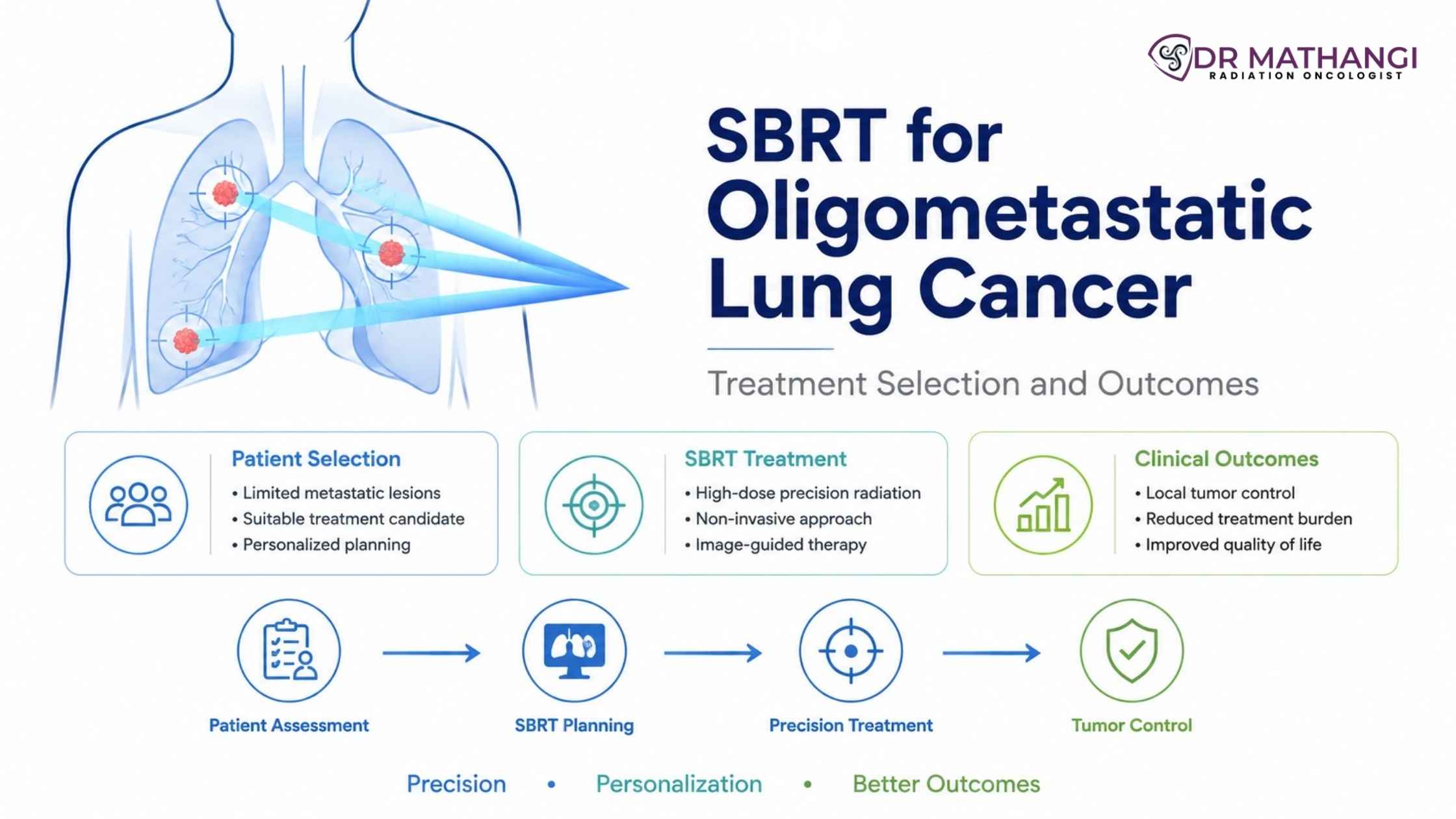
SBRT for Oligometastatic Lung Cancer: Treatment Selection and Outcomes
Author: Dr Mathangi J, Sr Consultant & In-charge - Radiation Oncology, Gleneagles Cancer Institute, Bangalore
What Is SBRT For Oligometastatic Lung Cancer?
Stereotactic body radiation therapy (SBRT) for lung cancer is a highly precise, non-invasive treatment that delivers concentrated radiation doses to lung tumors, offering hope even for patients with limited metastatic spread. According to recent studies, SBRT can achieve local control rates of over 85% for selected patients with oligometastatic lung cancer—a condition where a patient has a limited number (typically up to five) of metastatic tumors.
Dr Mathangi, Senior Radiation Oncologist at Gleneagles Cancer Institute, Bangalore, brings over 20 years of experience and global expertise to the forefront of cancer care. Her mastery in SBRT for lung cancer ensures patients in South India, North India, and beyond access world-class, evidence-based care. If you or your loved one faces the challenge of oligometastatic lung cancer, this guide will help you understand why choosing Dr Mathangi’s service could be a life-changing decision.
Why Is SBRT Considered For Oligometastatic Lung Cancer?
Oligometastatic lung cancer represents a clinical state where the disease has spread, but only to a limited extent—typically fewer than five sites. This concept has revolutionized the approach to metastatic cancer, as patients with this diagnosis may benefit from aggressive local therapies like SBRT, which can potentially improve survival and quality of life.
- SBRT for lung cancer offers a non-surgical, outpatient alternative for patients unfit for surgery.
- It targets tumors with millimeter precision, sparing healthy tissue and reducing recovery time.
- The high-dose, short-duration treatment can be completed in as few as 1-5 sessions.
Dr Mathangi’s expertise helps select patients most likely to benefit from this advanced approach, ensuring the best possible outcomes.
How Does Stereotactic Body Radiation Therapy Work?
Stereotactic body radiation therapy uses advanced imaging and planning to deliver focused radiation beams from multiple angles. This process ensures the highest dose to the tumor while minimizing exposure to surrounding organs.
- Detailed imaging (CT, MRI, PET) maps the tumor in 3D.
- Computerized planning systems create a personalized treatment plan.
- Motion management techniques account for tumor movement due to breathing.
- Precise radiation delivery occurs over a few brief sessions.
At Gleneagles Cancer Institute, Dr Mathangi employs cutting-edge technology such as TrueBeam STx and Gated RapidArc, offering unmatched accuracy and safety for patients.
What Is The Role Of The SABR-COMET Trial In SBRT For Lung Cancer?
The landmark SABR-COMET trial changed the landscape for treating oligometastatic cancers. This pivotal clinical trial demonstrated that adding SBRT to standard care in patients with oligometastatic disease significantly increased overall survival compared to standard palliative treatments alone.
- Patients receiving SBRT had a median overall survival of 41 months, compared to 28 months for standard therapy.
- SBRT also improved progression-free survival and local control rates.
- The trial validated the use of SBRT for lung cancer in cases of limited metastatic spread.
Dr Mathangi integrates these evidence-based findings into her practice, ensuring her patients receive globally benchmarked care for oligometastatic lung cancer.
How Are Patients Selected For SBRT In Oligometastatic Lung Cancer?
Careful patient selection is vital to maximize the benefits of SBRT for lung cancer. Not every patient is suitable; the decision is based on multiple factors:
- Number and location of metastases: Typically up to five lesions, all suitable for precise targeting.
- Overall health and performance status: Patients should be able to tolerate treatment.
- Pulmonary function assessment: Evaluates lung reserve to ensure safe radiation delivery.
- Stability of primary and other metastatic sites: Best outcomes are seen when the disease is otherwise stable or controlled.
Dr Mathangi’s comprehensive evaluation process includes advanced imaging, multidisciplinary tumor board discussions, and detailed pulmonary function assessment. This ensures that only those most likely to benefit are offered SBRT, optimizing safety and effectiveness.
How Is Motion Management Critical In Lung SBRT?
Motion management is an essential component in delivering safe and effective SBRT for lung cancer. Because tumors in the lung move as patients breathe, failure to account for this motion can result in missed targets or damage to healthy tissue.
- Techniques such as respiratory gating, DIBH (deep inspiration breath hold), and real-time tumor tracking are used.
- Gated RapidArc and advanced imaging ensure sub-millimeter accuracy.
- Motion management minimizes side effects and maximizes tumor control.
Dr Mathangi’s center is renowned for expertise in motion management, having pioneered the use of advanced gating technologies in the Asia Pacific region.
What Are The Lung SBRT Side Effects?
Understanding lung SBRT side effects is crucial for making an informed decision. While SBRT is generally well tolerated, some potential side effects include:
- Fatigue: Usually mild and short-lived.
- Cough or mild chest discomfort: May occur during or after treatment.
- Radiation pneumonitis: Inflammation of the lung tissue, usually manageable with medication.
- Rib pain or skin changes: Rare and typically mild.
The risk of severe complications is low when SBRT is administered by an experienced specialist like Dr Mathangi. Her meticulous planning and use of the latest technologies significantly reduce lung SBRT side effects, preserving lung function and quality of life.
What Are The Outcomes Of SBRT For Lung Cancer?
SBRT for lung cancer, especially in oligometastatic cases, has demonstrated excellent outcomes:
| Outcome | SBRT Result | Conventional Therapy |
|---|---|---|
| Local Control Rate | 85-95% | 50-60% |
| Overall Survival (2 years) | 55-70% | 30-40% |
| Treatment Duration | 1-2 weeks | 6-7 weeks |
| Quality of Life | Maintained/Improved | Variable |
Dr Mathangi’s patients at Gleneagles Cancer Institute consistently report high satisfaction and excellent functional outcomes, thanks to individualized care and access to the latest treatment protocols.
How To Book An Appointment With Dr Mathangi?
If you or your loved one is exploring options for oligometastatic lung cancer, time is of the essence. The right treatment, delivered by the right hands, can make all the difference. Don’t risk missing out on the most advanced, evidence-based care.
- Visit https://drmathangi.com/contact/.
- Fill in your contact information in the secure online form.
- Dr Mathangi’s team will promptly schedule your appointment and notify you of the details.
About Dr Mathangi
Dr Mathangi J is a Senior Radiation Oncologist and In-charge of the Radiation Oncology Department at Gleneagles Cancer Institute, Bangalore. With over 20 years of experience and advanced international training, she is recognized as a leader in cancer care across South India and North India. Her achievements include pioneering the installation of Asia Pacific’s first TrueBeam STx Machine and directing a prestigious Fellowship in Advanced Radiotherapy Techniques.
- Expertise in head and neck, brain, spine, lung, liver, breast, bladder, prostate, uterine, cervical, vulval, anal canal, and penile cancers.
- Over 12,000 patients successfully treated with a focus on patient-centered, precision medicine.
- Active educator and mentor, shaping the next generation of radiation oncologists through her RGUHS-affiliated fellowship program.
Choosing Dr Mathangi means choosing a globally respected, compassionate, and technologically advanced cancer care provider.
Frequently Asked Questions
What is SBRT for lung cancer and how is it different from conventional radiation?
SBRT for lung cancer, also known as stereotactic body radiation therapy, is a highly precise form of radiation that delivers very high doses to lung tumors over a few sessions (typically 3 to 5). Unlike conventional radiation, which is usually given over several weeks, SBRT targets tumors with sub-millimeter accuracy, sparing healthy tissue and reducing side effects. Dr. Mathangi utilizes advanced SBRT techniques to ensure optimal outcomes for patients with early-stage or oligometastatic lung cancer.
Who is an ideal candidate for SBRT in oligometastatic lung cancer?
Patients with oligometastatic lung cancer—meaning those with a limited number (usually up to 5) of metastatic lesions—may benefit from SBRT. Ideal candidates are those with controlled primary tumors, good overall health, and limited metastases that are safely accessible for radiation. Dr. Mathangi performs thorough evaluations, including imaging and pulmonary function assessment, to determine suitability and personalize treatment.
What evidence supports the use of stereotactic body radiation therapy for oligometastatic lung cancer?
The SABR-COMET trial provided strong evidence that stereotactic body radiation therapy (SBRT) improves survival and disease control in patients with oligometastatic cancer, including those with lung metastases. This landmark study demonstrated that aggressive local treatment like SBRT, when combined with systemic therapies, can offer meaningful survival benefits. Dr. Mathangi incorporates the latest evidence and guidelines to recommend SBRT when it is most likely to benefit each patient.
How does Dr. Mathangi assess pulmonary function before lung SBRT?
Pulmonary function assessment is a key step before proceeding with lung SBRT. Dr. Mathangi arranges for comprehensive lung function tests (such as spirometry and diffusion capacity) to evaluate if the patient’s lungs can safely tolerate radiation. This assessment helps tailor the treatment plan, minimize lung SBRT side effects, and ensure the best possible results for each individual.
What role does motion management play in SBRT for lung cancer?
Motion management is crucial in SBRT for lung cancer because tumors can move with breathing. Dr. Mathangi uses advanced imaging, 4D-CT scans, and real-time tracking techniques to ensure the radiation precisely targets the tumor during each breath cycle. Effective motion management reduces risks to healthy lung tissue and maximizes the safety and effectiveness of the treatment.
What are the common lung SBRT side effects and how are they managed?
Lung SBRT side effects are generally mild and may include fatigue, cough, mild chest discomfort, or shortness of breath. Occasionally, more serious effects like pneumonitis or rib fractures can occur. Dr. Mathangi takes proactive steps to minimize these risks through careful planning, personalized dosing, and regular follow-up. Most patients tolerate SBRT very well and recover quickly.
What kind of outcomes can patients expect after SBRT for oligometastatic lung cancer?
Patients treated with SBRT for oligometastatic lung cancer can expect excellent local control rates—often exceeding 85%—and potential improvements in overall survival, as supported by studies like the SABR-COMET trial. With Dr. Mathangi’s expertise and multidisciplinary approach, many patients experience durable disease control with minimal impact on quality of life.
How does Dr. Mathangi personalize SBRT treatment selection for lung cancer patients?
Dr. Mathangi customizes SBRT for lung cancer by considering tumor size, location, number of metastases, lung function, and patient preferences. She collaborates with a multidisciplinary team to ensure the treatment plan is evidence-based and tailored to each patient’s situation, maximizing benefits while minimizing risks.
Is SBRT an option for patients who cannot undergo surgery for lung metastases?
Yes, SBRT offers an effective, non-invasive alternative for patients with lung metastases who are not surgical candidates due to medical reasons or personal choice. Under Dr. Mathangi’s care, SBRT is delivered with precision and safety, providing a curative option for select individuals with oligometastatic lung cancer.