Radiation Therapy for Meningioma: Target Delineation and Long-Term Outcomes

What Is Radiation Therapy For Meningioma And Why Is It Important?
Radiation therapy for meningioma is a targeted treatment that uses high-energy rays to control or eliminate meningiomas—tumors arising from the meninges, the protective layers of the brain and spinal cord. Globally, meningiomas account for over 30% of all primary brain tumors, and while most are benign, their location can cause serious neurological issues. For patients who cannot undergo surgery or have residual tumor after surgery, radiation therapy for meningioma becomes a critical, non-invasive option.
At Gleneagles Cancer Institute, Bangalore, Dr Mathangi J—one of India’s leading radiation oncologists—provides state-of-the-art, personalized care for meningioma patients using the latest advances in radiation therapy. Her expertise ensures that patients receive optimal outcomes with minimal side effects, setting a new benchmark in brain tumor management in South and North India.
How Does Radiation Therapy For Meningioma Work?
Radiation therapy for meningioma works by delivering precise doses of radiation to the tumor, aiming to destroy cancerous cells while sparing healthy brain tissue. This approach is especially valuable for tumors located near critical structures where surgical removal would risk neurological function.
- Non-invasive treatment: No incisions or stitches required.
- High precision: Modern techniques like Stereotactic Radiosurgery (SRS) and Image-Guided Radiotherapy (IGRT) allow for pinpoint accuracy.
- Preserves quality of life: Fewer hospital stays and faster recovery compared to open surgery.
Dr Mathangi’s approach includes advanced planning with MRI fusion, meticulous target delineation, and comprehensive follow-up care to ensure the best possible prognosis.
What Are The Current Meningioma Treatment Options?
Meningioma treatment options generally depend on the tumor’s size, location, grade, and the patient’s overall health. The main options include:
- Observation: For small, asymptomatic tumors.
- Surgical resection: Preferred when feasible, especially for accessible tumors.
- Radiation therapy for meningioma: Essential for inoperable tumors, residual disease, or recurrent cases.
- Fractionated SRS meningioma: Highly focused radiation delivered in a few sessions for tumors close to sensitive structures.
At Gleneagles Cancer Institute, Dr Mathangi customizes the treatment plan, often leveraging radiation as a standalone or adjunct therapy to surgery to achieve the best outcomes.
What Is Benign Brain Tumor Radiation And When Is It Used?
Benign brain tumor radiation is used to treat non-cancerous brain tumors like meningiomas that are causing symptoms or are at risk of causing complications. This method is ideal when surgery is risky or not possible.
- Indicated for elderly or medically unfit patients.
- Used for tumors in challenging locations.
- Effective in controlling tumor growth and preventing recurrence.
With over 20 years of experience and more than 12,000 patients treated, Dr Mathangi’s protocols for benign brain tumor radiation are based on international guidelines and her advanced training from leading global centers.
How Is Target Delineation Achieved In Meningioma Radiation?
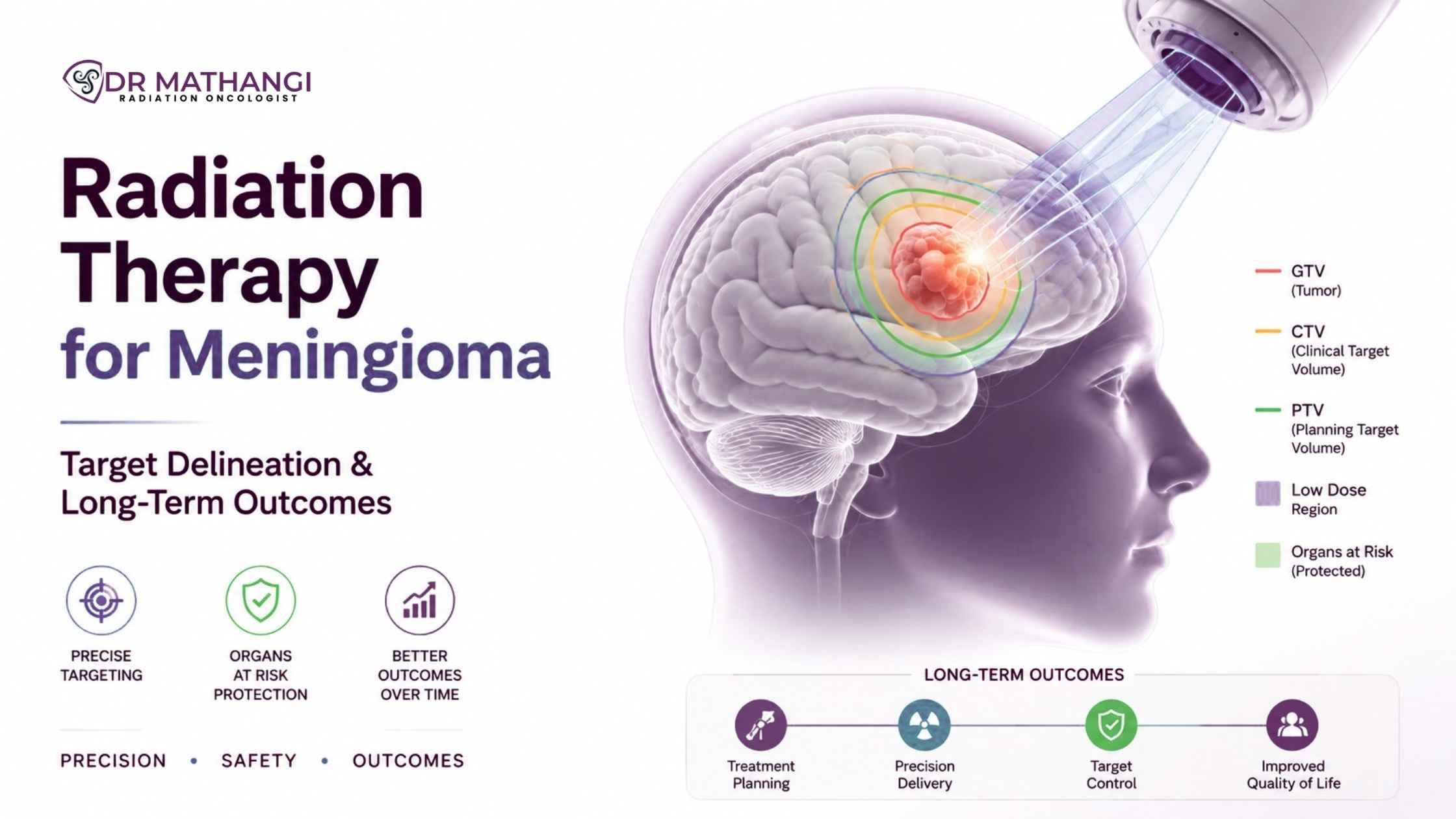
Target delineation is the process of accurately identifying the tumor boundaries and critical nearby structures on imaging studies before radiation. This is crucial for maximizing tumor control and minimizing side effects.
- Advanced MRI & CT fusion: Ensures exact tumor mapping.
- Dural tail contouring: Includes the “tail” of enhancement seen on MRI, which may harbor tumor cells.
- Inclusion of surgical cavity: For post-operative cases, the cavity is also contoured to cover residual disease.
- Protection of critical structures: Organs at risk, such as the optic chiasm and cranial nerves, are meticulously contoured and spared.
Dr Mathangi’s expertise in dural tail contouring and advanced stereotactic techniques ensures that every patient receives a highly personalized treatment plan, maximizing efficacy while protecting vital brain functions.
What Are Optic Chiasm Dose Constraints And Why Are They Critical?
Optic chiasm dose constraints are carefully calculated limits on the amount of radiation that can be delivered to the optic chiasm—the part of the brain where the optic nerves cross. Exceeding these limits risks vision loss.
- Standard constraint: Often <35 Gy (in fractionated treatments).
- Essential for tumors adjacent to the optic apparatus.
- Requires precise planning and daily image guidance.
By adhering to strict optic chiasm dose constraints, Dr Mathangi ensures that patients retain their vision while achieving maximum tumor control. Her use of advanced IGRT and adaptive radiotherapy techniques further enhances safety.
How Does Fractionated SRS Meningioma Improve Outcomes?
Fractionated SRS meningioma is a technique where the total radiation dose is divided into multiple smaller sessions (fractions), reducing the risk to adjacent healthy tissue while maintaining tumor control.
- Ideal for large tumors or those close to sensitive structures.
- Reduces risk of late toxicity compared to single-session SRS.
- Enables higher total doses for challenging cases.
Dr Mathangi’s training in Stereotactic techniques from Europe has enabled her to deliver fractionated SRS meningioma safely and effectively, resulting in superior long-term outcomes for her patients.
Why Is Cranial Nerve Preservation Essential In Meningioma Radiotherapy?
Cranial nerve preservation is a core goal in meningioma radiotherapy because these nerves control vital functions such as vision, hearing, facial movement, and swallowing. Damage to cranial nerves can significantly impact quality of life.
- Precision planning protects nerves adjacent to the tumor.
- Daily imaging ensures accuracy throughout treatment.
- Advanced software and beam modulation minimize exposure.
Dr Mathangi’s meticulous planning and use of high-end technology have established her as a leader in cranial nerve preservation during radiation therapy for meningioma, resulting in high rates of function retention.
What Are The Long-Term Outcomes of Radiation Therapy For Meningioma?
Long-term outcomes of radiation therapy for meningioma are highly favorable when performed by experienced specialists like Dr Mathangi. Multiple studies show:
- 5-year local control rates exceeding 90% for benign meningiomas.
- Low rates of severe complications when modern techniques are used.
- High rates of return to normal life and work.
Dr Mathangi’s patients benefit from comprehensive follow-up, MRI surveillance, and supportive care, ensuring that tumor recurrence is detected early and managed proactively.
Which Cancers Need Radiation Therapy And How Does Dr Mathangi Address Them?
According to Dr Mathangi, cancers that need RT (radiation therapy) include:
- Head and neck cancers
- Brain tumors (including meningioma)
- Spine tumors
- Esophagus and rectal cancers
- Lung cancers
- Liver cancers
- Breast cancers
- Bladder cancers
- Prostate cancers
- Uterine cancers
- Cervical cancer
- Vulval cancers
- Anal canal cancers
- Penile cancers
Her holistic approach, advanced technology, and individualized care protocols make her the preferred choice for radiation therapy across South and North India.
About Dr Mathangi J
Dr Mathangi J is a Senior Consultant and In-charge of Radiation Oncology at Gleneagles Cancer Institute, Bangalore. With over two decades of clinical experience, she has pioneered the adoption of cutting-edge radiotherapy techniques in India, including Stereotactic Ablative Body Radiotherapy (SBRT), Gated RapidArc, DIBH gated RT, and image-guided interstitial brachytherapy.
- Trained at leading centers in Germany, Denmark, and Chennai.
- Director of Fellowship in Advanced Radiotherapy Techniques (RGUHS).
- Installed Asia Pacific’s first TrueBeam STx Machine.
- Specializes in head and neck, prostate, brain, lung, and women’s cancers.
Her dedication, clinical acumen, and patient-centric approach have touched the lives of thousands. Patients from all over India seek her expertise for complex tumors, knowing they will receive care that is both compassionate and world-class.
Ready To Take The Next Step?
Don’t miss out on expert care from one of India’s most trusted radiation oncologists. To book your consultation with Dr Mathangi J at Gleneagles Cancer Institute, Bangalore, submit your contact information here. Her team will contact you to schedule your appointment and guide you through the next steps.
Summary Table: Key Considerations In Radiation Therapy For Meningioma
| Aspect | Dr Mathangi’s Approach |
|---|---|
| Target delineation | Advanced imaging, dural tail contouring, inclusion of surgical cavity. |
| Optic chiasm dose constraints | Strict adherence to international safety limits to preserve vision. |
| Cranial nerve preservation | Meticulous contouring, daily IGRT, and adaptive planning. |
| Fractionated SRS meningioma | Personalized schedules to maximize benefit and minimize risk. |
| Long-term outcomes | High tumor control, low complication rates, excellent quality of life. |
| Meningioma treatment options | Custom blend of surgery, radiation, and follow-up as per case. |
Why Choose Dr Mathangi For Radiation Therapy For Meningioma?
- Unparalleled expertise in advanced radiation techniques.
- Personalized treatment plans based on the latest global protocols.
- Proven track record with thousands of successful patient outcomes.
- Comprehensive patient support and education throughout your journey.
Missing the opportunity to be treated by Dr Mathangi means missing a chance at the best possible outcome for you or your loved one. Her pioneering work, transparent communication, and patient-first philosophy set her apart as a leader in the field.
Conclusion
Radiation therapy for meningioma, when executed with precision and compassion, offers outstanding long-term outcomes and preserves neurological function. Dr Mathangi J’s world-class expertise, innovative technology use, and commitment to patient well-being make her the go-to specialist for patients seeking the highest standard of care in Bangalore, South India, and North India. Take the first step toward a healthier future—reach out to Dr Mathangi’s team and secure your comprehensive treatment evaluation today.
Frequently Asked Questions
What is involved in radiation therapy for meningioma and how does Dr. Mathangi approach target delineation?
Radiation therapy for meningioma is a precise treatment that targets tumor cells while sparing healthy brain tissue. Dr. Mathangi utilizes advanced imaging and meticulous planning to delineate the tumor boundaries, ensuring optimal radiation coverage. This approach reduces the risk of recurrence and minimizes side effects by focusing radiation only where it’s needed most.
How does benign brain tumor radiation differ from surgery, and what are the benefits?
Benign brain tumor radiation, such as that used for meningiomas, is non-invasive and does not require anesthesia or a hospital stay. Compared to surgery, radiation has a lower risk of complications and is ideal for tumors in hard-to-reach locations or for patients who cannot undergo surgery. Dr. Mathangi’s protocols are tailored to maximize tumor control while maintaining quality of life.
What is fractionated SRS meningioma and when is it recommended?
Fractionated SRS meningioma involves delivering highly focused radiation in multiple small doses over several sessions. This method is especially valuable when the tumor is close to sensitive structures like the optic nerves. Dr. Mathangi recommends this approach to enhance tumor control while reducing the risk of side effects, especially for larger or critically located meningiomas.
Why are optic chiasm dose constraints important in meningioma radiation therapy?
The optic chiasm dose constraints are critical to prevent vision loss. Dr. Mathangi applies strict dose limitations to the optic chiasm and surrounding visual pathways during planning, especially when tumors are nearby. This ensures that the risk of radiation-induced optic neuropathy is minimized, preserving patients’ sight and quality of life.
What is dural tail contouring and how does it affect meningioma treatment outcomes?
Dural tail contouring involves outlining the area of thickened dura mater (the “dural tail”) seen on MRI that may harbor microscopic tumor cells. Dr. Mathangi carefully includes relevant portions of the dural tail in the treatment volume to ensure comprehensive tumor coverage, which is associated with improved long-term outcomes and reduced risk of recurrence.
How does Dr. Mathangi prioritize cranial nerve preservation during radiation therapy?
Cranial nerve preservation is a top priority in Dr. Mathangi’s radiation planning. By using advanced imaging and precise targeting, she carefully contours and protects critical nerves in the brain. This approach reduces the risk of nerve injury, helping patients avoid complications like facial weakness, hearing loss, or swallowing difficulties.
What meningioma treatment options are available, and how does radiation fit into the overall plan?
Meningioma treatment options include observation (watchful waiting), surgical removal, and radiation therapy. Radiation is often chosen for tumors that are inoperable, recurrent, or located near vital structures. Dr. Mathangi provides comprehensive guidance, helping patients select the best approach based on tumor size, location, and overall health.
What are the long-term outcomes of radiation therapy for meningioma, based on Dr. Mathangi’s experience?
Long-term outcomes of radiation therapy for meningioma are generally excellent, with high rates of tumor control and low rates of serious side effects. Dr. Mathangi’s patients benefit from advanced techniques that enhance safety and effectiveness, and she closely monitors each patient’s progress to ensure the best possible quality of life after treatment.
What follow-up care does Dr. Mathangi recommend after radiation therapy for meningioma?
After radiation therapy, Dr. Mathangi recommends regular MRI scans and neurological assessments to monitor for recurrence and assess brain function. She provides detailed follow-up schedules and supportive care, addressing any late effects and ensuring patients have ongoing access to guidance and intervention as needed.