Real-Time Motion Management in Radiotherapy: Calypso vs Surface Guided Radiation Therapy (SGRT)
By Dr Mathangi J, Sr Consultant & In-charge - Radiation Oncology, Gleneagles Cancer Institute, Bangalore
What Is Motion Management In Radiotherapy And Why Does It Matter?
Motion management in radiotherapy is the suite of techniques and technologies designed to ensure that radiation is delivered precisely to cancerous tissues, even as the patient or tumor moves during treatment. According to the American Cancer Society, more than 60% of all cancer patients will receive radiotherapy at some point in their treatment journey. Precise motion management is crucial—without it, up to 30% of treatments risk missing the target, potentially reducing effectiveness and increasing side effects.
Dr Mathangi J, a leading expert in advanced radiation oncology at Gleneagles Cancer Institute, Bangalore, is at the forefront of implementing real-time solutions like Calypso and Surface Guided Radiation Therapy (SGRT), ensuring that each patient receives the safest and most effective care possible.
How Do Calypso And SGRT Compare In Real-Time Tumor Tracking?
Real-time tumor tracking involves continuously monitoring the location of a tumor during radiation delivery, so any movement—whether due to breathing, swallowing, or other involuntary motions—can be instantly accounted for. Both Calypso and SGRT offer real-time solutions, but their approaches differ fundamentally.
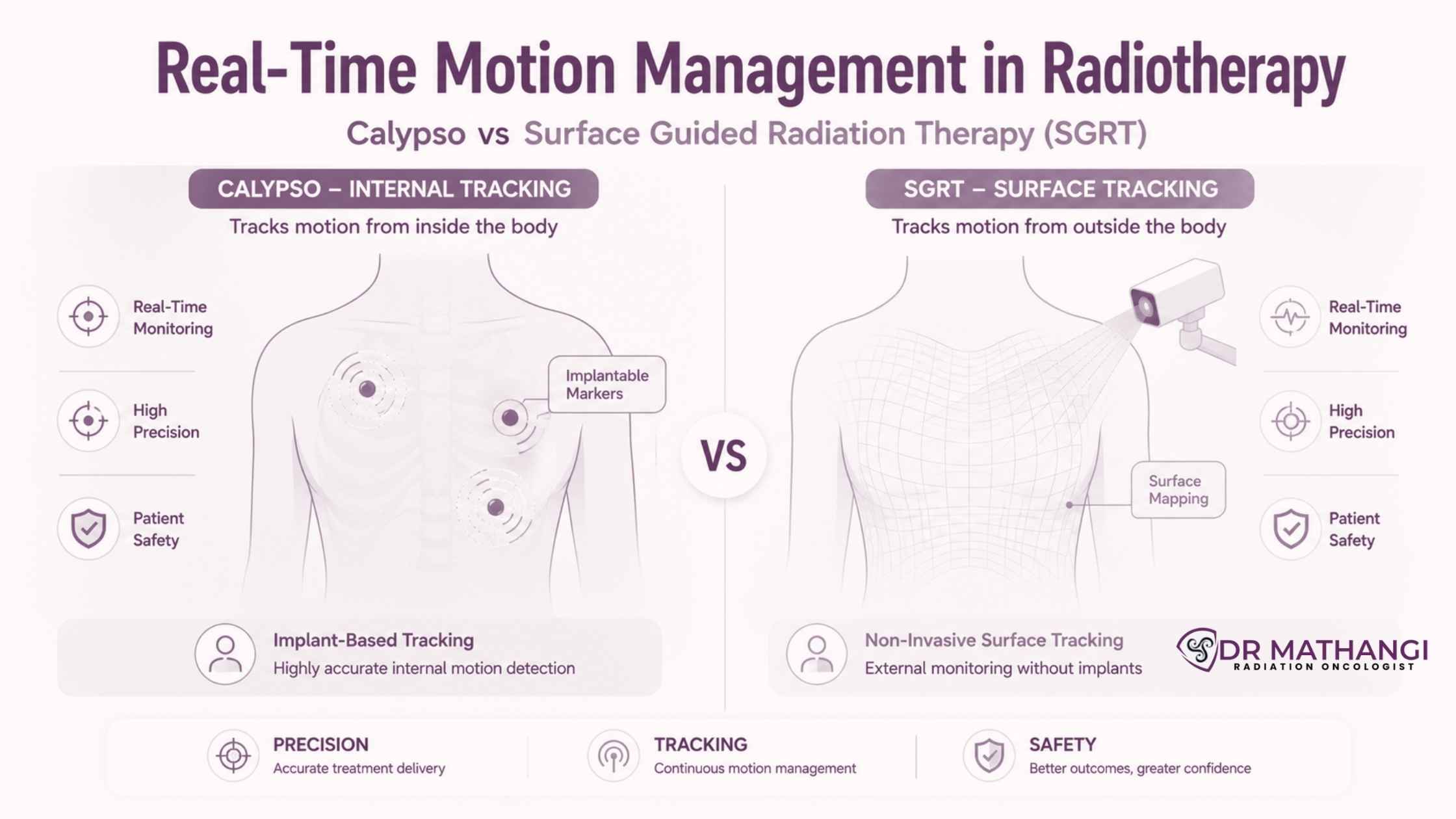
- Calypso: Uses electromagnetic transponders (miniature beacons) implanted near or in the tumor. These beacons send live positional data to a monitoring system, allowing for sub-millimeter accuracy.
- Surface Guided Radiation Therapy (SGRT): Employs advanced 3D optical surface imaging to track the contour of the patient’s skin in real time, detecting even minute shifts during treatment.
Dr Mathangi’s expertise ensures that the choice between these technologies is tailored to each patient’s anatomy, tumor location, and cancer type, maximizing outcomes and minimizing risks.
Why Is Surface Guided Radiation Therapy (SGRT) Transforming Cancer Care?
Surface guided radiation therapy (SGRT) is a game-changer, especially for cancers where traditional immobilization is challenging. SGRT leverages non-invasive cameras and sophisticated software to create a 3D map of the patient’s surface. Throughout treatment, this system constantly compares the real-time patient position to the planned treatment position, ensuring accuracy without the need for tattoos, marks, or invasive procedures.
- Reduces patient discomfort and anxiety
- Improves accuracy for breast, head and neck, and brain cancers
- Eliminates the need for permanent skin markings
- Enables breast radiation tracking and facilitates respiratory gating for deep inspiration breath hold (DIBH) in left-sided breast cancers
At Gleneagles Cancer Institute, under Dr Mathangi’s leadership, SGRT is now a standard part of protocols for many cancer types, ensuring each patient benefits from state-of-the-art, compassionate care.
What Role Does Calypso Play In Intra-Fraction Motion Monitoring?
Intra-fraction motion monitoring refers to tracking and managing any movement of the tumor or patient during each individual treatment session (“fraction”). Calypso’s electromagnetic tracking system provides continuous, real-time updates on the tumor’s exact position, alerting clinicians if the target moves beyond an acceptable threshold. This enables:
- Immediate pausing of radiation if excessive motion is detected
- Automated adjustments to maintain target alignment
- Enhanced precision for prostate, liver, and other moving tumors
Dr Mathangi’s advanced training in IGRT, SBRT, and gated RapidArc makes her uniquely qualified to harness Calypso’s full capabilities, especially in complex cases where sub-millimeter accuracy is non-negotiable.
How Does Respiratory Gating Improve Outcomes In Radiation Therapy?
Respiratory gating is a critical technology that synchronizes the delivery of radiation with the patient’s breathing cycle. This is especially important for tumors in the lungs, liver, or near the diaphragm, where movement during respiration can shift the target by several centimeters.
- Both Calypso and SGRT can be integrated with respiratory gating systems
- Allows for precise targeting only when the tumor is in the optimal position
- Reduces exposure to healthy surrounding tissues
Dr Mathangi routinely employs respiratory gating for lung, liver, and left-sided breast cancers, combining it with real-time motion management tools for best-in-class safety and accuracy.
Why Are Fiducial Markers Used In Motion Management In Radiotherapy?
Fiducial markers are tiny reference points (often gold seeds or electromagnetic beacons) implanted within or near the tumor. They serve as visible or trackable landmarks for imaging and real-time monitoring systems, making it possible to align and verify the treatment target with unmatched precision.
- Essential for prostate, liver, and pancreatic cancers
- Facilitate accurate alignment in Calypso and other IGRT systems
- Reduce setup errors and enhance confidence in treatment delivery
Dr Mathangi’s expertise in image-guided radiotherapy ensures that fiducial markers are used judiciously and safely, balancing benefits against any potential risks.
How Is Breast Radiation Tracking Enhanced With SGRT?
Breast radiation tracking has evolved dramatically with the adoption of SGRT. For left-sided breast cancers, where the heart is at risk, SGRT enables Deep Inspiration Breath Hold (DIBH) techniques, allowing patients to take a deep breath and hold it during treatment. This moves the heart away from the chest wall, dramatically reducing cardiac exposure.
- Non-contact, real-time monitoring of breast position
- DIBH protocols for superior heart sparing
- No need for permanent tattoos or marks
- Enhanced patient comfort and confidence
Dr Mathangi has pioneered the use of SGRT for breast cancer patients in Bangalore, establishing protocols that have become benchmarks for excellence across South India.
Which Cancers Benefit Most From Real-Time Motion Management?
Real-time motion management in radiotherapy is especially critical for cancers where tumor motion is significant or where adjacent organs are highly sensitive. At Gleneagles Cancer Institute, Dr Mathangi routinely deploys these technologies for:
- Head and neck cancers
- Brain tumors
- Spine tumors
- Esophagus and rectal cancers
- Lung cancers
- Liver cancers
- Breast cancers
- Bladder cancers
- Prostate cancers
- Uterine cancers
- Cervical cancer
- Vulval cancers
- Anal canal cancers
- Penile cancers
By choosing Dr Mathangi, patients gain access to the very latest in motion management technologies, tailored to their specific diagnosis and anatomy.
Why Choose Dr Mathangi For Advanced Motion Management In Radiotherapy?
Dr Mathangi J is one of India’s most accomplished radiation oncologists, with over 20 years of experience and 12,000+ patients successfully treated. Her credentials include:
- MBBS, DMRT (Madras Medical College), DNB (Apollo Cancer Specialty Hospital)
- Advanced training in SRS/SBRT (Germany), IGRT/RapidArc (Denmark), and IORT (Europe)
- Pioneered Asia Pacific’s first TrueBeam STx Machine
- Director of Fellowship in Advanced Radiotherapy Techniques (RGUHS)
- Expert in SBRT, Gated RapidArc, DIBH gated radiotherapy, and image-guided interstitial brachytherapy
When you choose Dr Mathangi, you’re not just accessing technology—you’re benefiting from a legacy of clinical excellence, innovation, and compassionate care.
Don’t miss out on the advantage that real-time motion management in radiotherapy can offer you or your loved one. For a personalized consultation or to book an appointment, submit your contact information on the official contact form. Dr Mathangi’s team will promptly schedule a visit and guide you on your next steps toward advanced, safe, and effective cancer care.
About Dr Mathangi J
Dr Mathangi J is the Senior Consultant and In-charge of Radiation Oncology at Gleneagles Cancer Institute, Bangalore. She is widely recognized for her leadership in clinical innovation, commitment to patient safety, and expertise in cutting-edge radiotherapy techniques—including motion management in radiotherapy, real-time tumor tracking, surface guided radiation therapy, and more. Her reputation as a patient advocate and educator makes her the preferred choice for individuals and families seeking world-class cancer care in India.
Frequently Asked Questions
What is motion management in radiotherapy, and why is it important?
Motion management in radiotherapy refers to the strategies and technologies used to detect, monitor, and compensate for patient or tumor movement during radiation treatment. This is essential because organs and tumors can move due to breathing or other physiological processes. Effective motion management ensures that the radiation dose accurately targets the tumor while sparing healthy tissues. Dr. Mathangi incorporates advanced solutions to optimize safety and precision for each patient.
How does Calypso enable real-time tumor tracking during radiotherapy?
The Calypso system uses tiny electromagnetic transponders, also known as fiducial markers, which are implanted in or near the tumor. These markers communicate with an external array, allowing for real-time tumor tracking with sub-millimeter accuracy during treatment. This technology helps to detect and correct for intra-fraction motion monitoring, ensuring the radiation beam remains precisely aligned with the tumor throughout therapy. Dr. Mathangi recommends Calypso for cases where high precision is required, such as prostate or other soft-tissue tumors.
What is surface guided radiation therapy (SGRT), and what are its advantages?
Surface guided radiation therapy (SGRT) is a non-invasive technology that uses 3D cameras to continuously monitor the patient’s surface in real-time. By tracking the patient’s position and movement, SGRT helps ensure accurate beam delivery and can automatically pause treatment if the patient moves outside a set threshold. SGRT is especially valuable in breast radiation tracking, stereotactic treatments, and cases where patient comfort and setup reproducibility are critical. Dr. Mathangi offers SGRT as a standard of care for suitable patients.
How do Calypso and SGRT differ in their approach to intra-fraction motion monitoring?
Calypso relies on implanted fiducial markers to track internal tumor movement, making it ideal for deep-seated tumors or those that can't be visualized with external methods. SGRT, on the other hand, monitors the patient’s external surface using optical cameras, making it completely non-invasive and highly effective for treatments where surface changes reflect internal motion, such as in breast or head and neck radiotherapy. Both systems excel at intra-fraction motion monitoring, and Dr. Mathangi determines the best approach based on tumor location and patient preferences.
What role do fiducial markers play in real-time motion management?
Fiducial markers are tiny, biocompatible implants placed near or within the tumor to serve as reference points for imaging and tracking. In systems like Calypso, they allow for continuous, real-time tumor tracking by sending signals to an external array. This ensures the radiation beam dynamically follows the tumor even if it moves during treatment. Dr. Mathangi carefully evaluates the use of fiducial markers based on tumor type, patient comfort, and clinical need.
How is respiratory gating incorporated into motion management strategies?
Respiratory gating is a technique used to synchronize radiation delivery with the patient’s breathing cycle, minimizing the impact of tumor movement caused by respiration. Both Calypso and SGRT can be integrated with respiratory gating systems. For example, SGRT can monitor chest wall movement in real-time, while Calypso can detect fiducial marker displacement due to breathing. Dr. Mathangi tailors the use of respiratory gating to each patient’s unique anatomy and tumor location for the best possible outcomes.
In what scenarios is surface guided radiation therapy preferred over Calypso?
Surface guided radiation therapy is preferred in cases where non-invasive setup and monitoring are important, such as in breast radiation tracking, cranial tumors, and pediatric treatments. It is also valuable for patients who may not be suitable candidates for fiducial marker implantation. SGRT is highly effective for monitoring patient position and movement, particularly when external surface changes reflect internal target movement. Dr. Mathangi discusses the most appropriate modality with each patient based on the specifics of their diagnosis and comfort.
How does Dr. Mathangi determine whether to use Calypso or SGRT for a patient?
Dr. Mathangi evaluates several factors such as tumor location, patient anatomy, clinical indications, and patient preferences. For tumors that are deep-seated or not easily visualized externally, Calypso with fiducial markers may be recommended for precise real-time tumor tracking. For superficial tumors or when a non-invasive approach is desired, surface guided radiation therapy is often preferred. Dr. Mathangi’s patient-centric approach ensures the most effective and comfortable solution is selected.
What are the benefits of advanced motion management for breast radiation tracking?
For breast radiation tracking, advanced motion management techniques like SGRT provide continuous monitoring of breast position and movement, ensuring the radiation is delivered only when the patient is correctly positioned. This reduces exposure to the heart and lungs and improves treatment accuracy. Dr. Mathangi incorporates these technologies to enhance patient safety, comfort, and treatment outcomes in breast cancer radiotherapy.