Neoadjuvant vs Adjuvant Radiation Therapy for Rectal Cancer: Staging Frameworks and Treatment Decisions
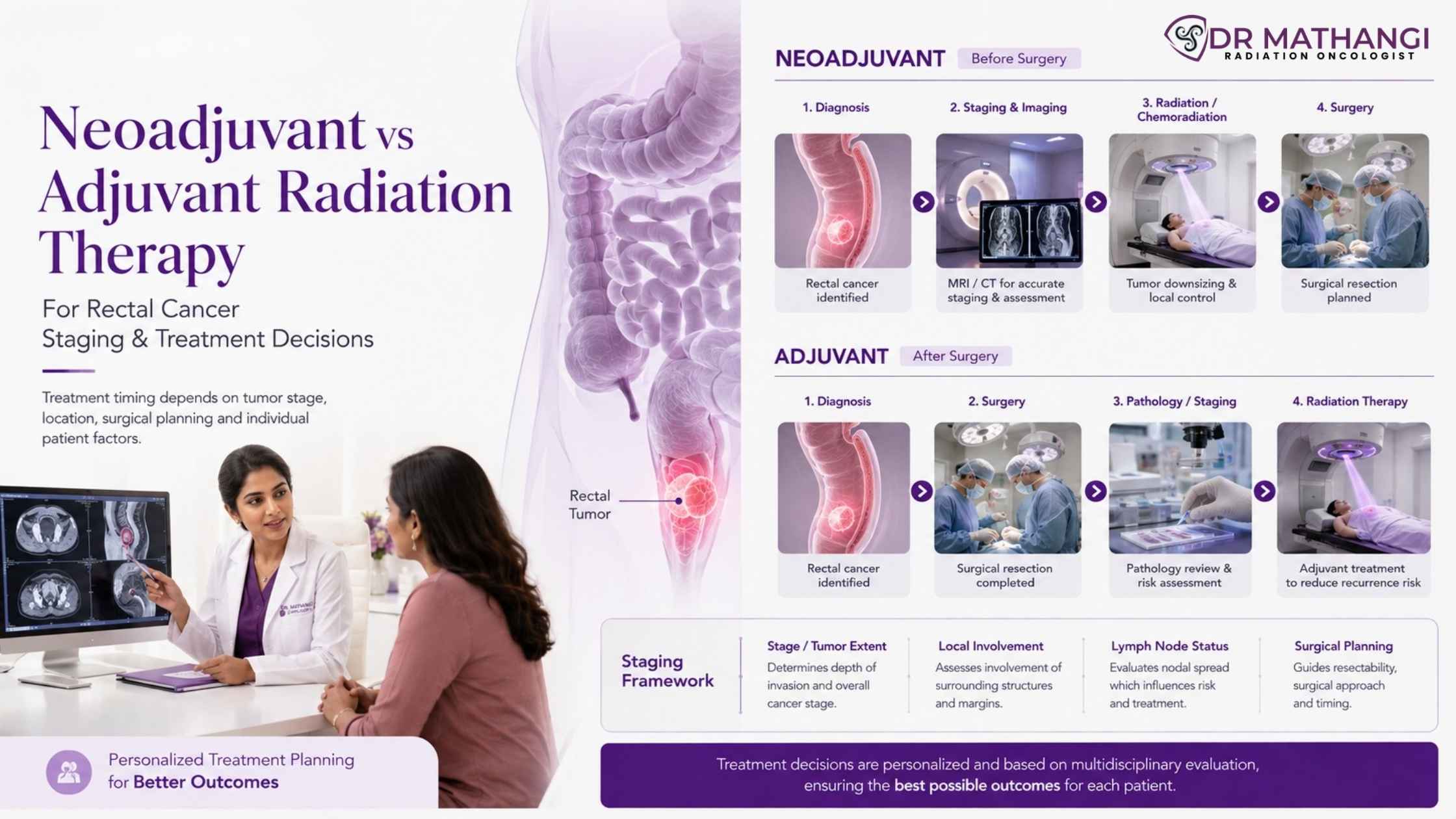
Why Is Accurate Staging Essential In Rectal Cancer Radiation Therapy?
Rectal cancer radiation therapy forms a cornerstone in the multidisciplinary management of rectal cancer, contributing significantly to improved local control, sphincter preservation, and overall survival. According to the World Health Organization, colorectal cancer ranks as the third most common cancer worldwide, with rectal cancer accounting for a large proportion of these cases. In India, the incidence is steadily rising, making timely access to expert-driven, evidence-based care crucial.
Accurate staging is the linchpin for tailoring treatment—determining the sequence and modality of radiation therapy. Pelvic MRI staging is now the global gold standard, offering unparalleled detail in assessing tumor depth, lymph node involvement, and relationship to critical anatomical structures such as the circumferential resection margin (CRM). These insights directly influence whether a patient is best suited for neoadjuvant (preoperative) or adjuvant (postoperative) radiation therapy, and whether advanced surgical approaches like total mesorectal excision can be safely performed.
How Do Staging Frameworks Guide Treatment Decisions In Rectal Cancer?
Staging frameworks integrate clinical, radiological, and pathological data to stratify patients into optimal treatment pathways. The TNM system—emphasizing Tumor (T), Node (N), and Metastasis (M)—remains the foundation, but modern practice employs MRI-based subcategories:
- cT3 rectal cancer: Tumor extends beyond the muscularis propria but not to adjacent organs.
- cT4 rectal cancer: Tumor invades neighboring structures like the bladder, prostate, or uterus.
The proximity of the tumor to the circumferential resection margin is meticulously evaluated. CRM clearance—defined as a margin of at least 1mm between tumor and mesorectal fascia—is a critical predictor of local recurrence. Tumors threatening or involving the CRM generally necessitate neoadjuvant therapy for downsizing and better surgical outcomes.
What Is Neoadjuvant (Preoperative) Radiation Therapy?
Neoadjuvant radiation therapy—administered before surgical intervention—aims to shrink the tumor, facilitate resection, and reduce recurrence risk. There are two main approaches:
- Preoperative short course radiation: Delivers 25 Gy in 5 fractions over one week, followed by prompt surgery (within 7-10 days).
- Long-course chemoradiation: Involves 45-50.4 Gy in 25-28 fractions over 5-6 weeks, with concurrent chemotherapy, followed by surgery after 6-8 weeks.
Indications for neoadjuvant therapy typically include cT3 rectal cancer, cT4 rectal cancer, node-positive disease, and tumors close to the mesorectal fascia or anal sphincter.
The primary benefits of neoadjuvant therapy are:
- Higher rates of sphincter preservation rectal cancer, especially in low-lying tumors
- Downstaging of tumors, making total mesorectal excision more feasible
- Improved CRM clearance and reduced local recurrence
- Lower acute toxicity compared to adjuvant therapy
Preoperative radiotherapy for rectal cancer is now the standard of care for locally advanced cases, as endorsed by leading international guidelines and substantiated by robust clinical trial evidence.
When Is Adjuvant (Postoperative) Radiation Therapy Indicated?
Adjuvant radiation therapy is considered when high-risk pathological features are discovered after surgery. These may include positive margins, extensive nodal involvement, or upstaged disease not identified during initial staging. However, the trend is to minimize adjuvant therapy in favor of preoperative approaches, as postoperative radiation is associated with higher rates of toxicity and lower efficacy in reducing local recurrence.
In scenarios where neoadjuvant therapy was not feasible or if unexpected adverse features are found postoperatively, adjuvant therapy remains a vital tool in the oncologist’s armamentarium.
Comparing Neoadjuvant And Adjuvant Radiation Therapy: Which Is Superior?
Neoadjuvant radiation therapy is generally preferred for locally advanced rectal cancer due to superior local control, increased sphincter preservation, and lower toxicity, as confirmed by multiple randomized trials and guidelines.
| Aspect | Neoadjuvant Radiation Therapy | Adjuvant Radiation Therapy |
|---|---|---|
| Timing | Before surgery | After surgery |
| Tumor Downstaging | Yes (significant) | No |
| Sphincter Preservation | Higher rates | Lower rates |
| Toxicity | Lower | Higher |
| CRM Clearance | Improved | Variable |
| Guideline Recommendation | Preferred for locally advanced disease | For select high-risk cases only |
How Does Dr Mathangi Individualize Treatment Planning For Rectal Cancer?
At Gleneagles Cancer Institute, Dr Mathangi leverages her advanced training and extensive experience to deliver personalized, evidence-driven care. She combines:
- High-resolution pelvic MRI staging for precise tumor mapping
- Multidisciplinary tumor board discussions to align surgery, radiation, and systemic therapy
- Innovative techniques such as Stereotactic Body Radiotherapy (SBRT), Gated RapidArc, and IGRT for optimal targeting and protection of healthy tissue
- Patient-centered decision-making, prioritizing quality of life and functional outcomes
Dr Mathangi’s approach ensures every patient receives a treatment plan tailored to their cancer stage, anatomical considerations, and personal preferences—maximizing survival and minimizing side effects.
What Are The Steps Involved In Preoperative Radiotherapy For Rectal Cancer?
- Comprehensive Assessment: Clinical evaluation, colonoscopy, and pelvic MRI staging
- Tumor Board Review: Multidisciplinary discussion for consensus on the best treatment sequence
- Preoperative Radiotherapy: Choice of preoperative short course radiation or long-course chemoradiation based on tumor stage and location
- Interval To Surgery: Surgery (usually total mesorectal excision) is timed post-radiation for optimal downstaging
- Pathological Review: Assessment of CRM clearance and nodal status to determine if further therapy is needed
Why Is CRM Clearance Crucial For Long-Term Outcomes?
CRM clearance is a major determinant of local recurrence and survival in rectal cancer. Failure to achieve an adequate margin (<1mm) is associated with a significantly higher risk of cancer returning in the pelvis. Neoadjuvant therapy, by shrinking tumors away from the fascia, increases the likelihood of achieving a negative CRM and thus long-term cure.
Which Cancers Benefit From Radiation Therapy According To Dr Mathangi?
- Head and neck cancers
- Brain tumors
- Spine tumors
- Esophagus and rectal cancers
- Lung cancers
- Liver cancers
- Breast cancers
- Bladder cancers
- Prostate cancers
- Uterine cancers
- Cervical cancer
- Vulval cancers
- Anal canal cancers
- Penile cancers
If you or a loved one is facing a diagnosis of rectal or any of the above cancers, timely expert intervention can change the trajectory of your care and outcomes.
Entrust your care to Dr Mathangi, whose expertise, advanced technology, and compassionate approach ensure you receive the best possible outcome.
Book your appointment here and join the thousands of patients who have benefited from her exceptional care at Gleneagles Cancer Institute, Bangalore. Her team will promptly schedule your consultation and notify you with all necessary details.
About Dr Mathangi: A Leader In Oncology
Dr Mathangi J is a highly respected senior radiation oncologist, educator, and innovator in cancer care across South and North India. Her academic credentials, clinical experience, and pioneering achievements—including the installation of Asia Pacific’s first TrueBeam STx Machine—set her apart as a top choice for patients seeking state-of-the-art, personalized oncological care.
Her holistic, patient-focused philosophy is reflected in her leadership at Gleneagles Cancer Institute and her role as Director of Fellowship in Advanced Radiotherapy Techniques. When you choose Dr Mathangi, you are opting for the gold standard in cancer management.
Frequently Asked Questions
What is the difference between neoadjuvant and adjuvant radiation therapy for rectal cancer?
Neoadjuvant radiation therapy is given before surgery, while adjuvant therapy is delivered after surgery. For rectal cancer radiation therapy, neoadjuvant (preoperative) approaches are often preferred because they can shrink the tumor, improve surgical outcomes, and reduce the risk of local recurrence. Dr. Mathangi emphasizes that the decision is based on tumor stage, imaging findings, and patient-specific factors.
How does pelvic MRI staging influence treatment planning in rectal cancer?
Pelvic MRI staging is crucial for accurately determining the tumor's local extent, involvement of surrounding structures, and the status of the circumferential resection margin (CRM). Dr. Mathangi utilizes pelvic MRI staging to guide whether preoperative radiotherapy for rectal cancer is indicated, and to tailor the surgical and radiation approach to maximize outcomes and minimize unnecessary treatment.
When is preoperative short course radiation used in rectal cancer treatment?
Preoperative short course radiation is typically used for resectable rectal tumors at intermediate risk, such as mid or low cT3 rectal cancer without threatened CRM. Dr. Mathangi explains that this approach offers effective tumor downstaging, can be completed quickly (usually within one week), and is followed by timely surgery, making it ideal for selected patients.
What is the significance of CRM clearance in rectal cancer surgery?
CRM (circumferential resection margin) clearance means that no tumor is found close to the outer edge of the tissue removed during total mesorectal excision. Achieving CRM clearance is vital because it reduces the risk of local recurrence. Dr. Mathangi uses advanced imaging and preoperative radiotherapy for rectal cancer to help secure CRM clearance, especially in borderline cases.
How does Dr. Mathangi approach sphincter preservation in rectal cancer?
Sphincter preservation rectal cancer strategies focus on avoiding permanent colostomy when possible. Dr. Mathangi integrates neoadjuvant therapies, detailed pelvic MRI staging, and precise surgical planning to shrink tumors and allow for sphincter-saving surgery, always prioritizing patient quality of life and oncological safety.
What are the differences in treatment for cT3 and cT4 rectal cancer?
cT3 rectal cancer indicates tumor invasion through the muscularis propria but not into nearby organs, while cT4 rectal cancer invades adjacent organs or structures. Dr. Mathangi tailors the treatment: cT3 cases may be managed with short or long course preoperative radiation, while cT4 cases often require long course chemoradiation and multidisciplinary planning to optimize surgical resection and maximize CRM clearance.
Why is total mesorectal excision important in rectal cancer management?
Total mesorectal excision (TME) is a surgical technique that removes the rectum along with the surrounding mesorectal fat and lymph nodes. This method is the gold standard for rectal cancer surgery, as it improves local control and reduces recurrence. Dr. Mathangi ensures TME is combined with the most appropriate neoadjuvant or adjuvant therapy based on the patient's staging and risk profile.
How does Dr. Mathangi decide between neoadjuvant and adjuvant therapy for individual patients?
Dr. Mathangi utilizes a comprehensive assessment—combining clinical examination, pelvic MRI staging, and multidisciplinary input—to determine if a patient would benefit more from neoadjuvant or adjuvant therapy. The goal is to maximize local control, facilitate sphincter preservation rectal cancer options, and minimize toxicity, always individualizing care for the best outcomes.
What are the main goals of rectal cancer radiation therapy?
The main goals of rectal cancer radiation therapy are to reduce tumor size (downstaging), improve surgical success, achieve CRM clearance, lower recurrence risks, and preserve sphincter function when possible. Dr. Mathangi offers advanced protocols and multidisciplinary collaboration to achieve these objectives, ensuring patient-centric, evidence-based care.