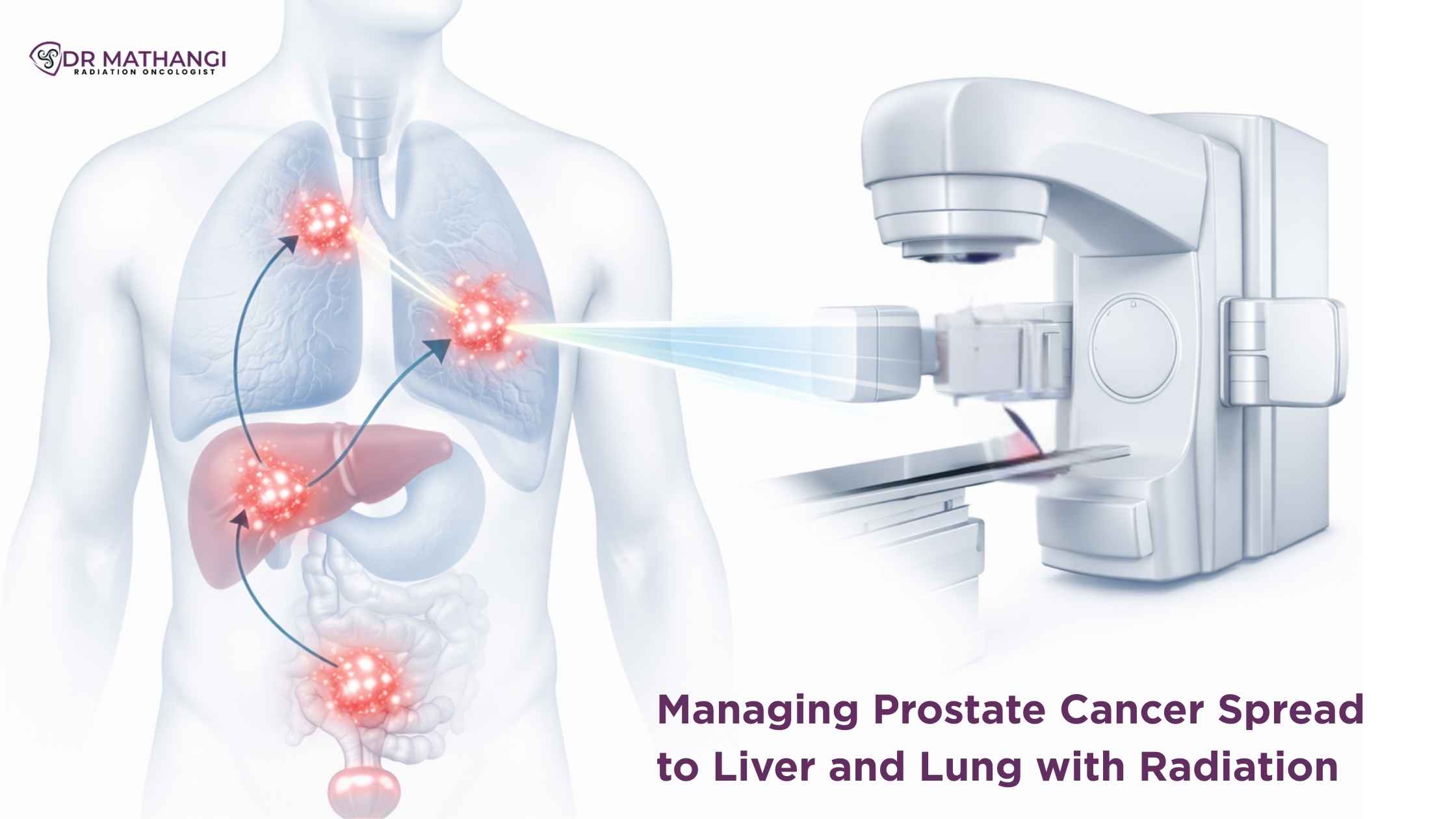
Prostate cancer is the second most commonly diagnosed cancer in men worldwide, and when it spreads beyond the prostate, survival outcomes depend heavily on timely, advanced intervention. Managing Prostate Cancer Spread to Liver and Lung with Radiation has emerged as a highly effective strategy in carefully selected patients, especially when delivered by an experienced radiation oncologist like Dr Mathangi.
When prostate cancer advances to distant organs such as the liver and lungs, it is categorized as metastatic disease. These are known as visceral metastases prostate cancer, and they demand highly specialized care. At this stage, patients often feel uncertainty about prognosis, life expectancy with metastasis, and available prostate cancer metastasis treatment options. This is where expertise, technology, and precision converge to make a meaningful difference.
When prostate cancer spreads to the liver and lungs, cancer cells travel through the bloodstream or lymphatic system and establish new tumors in these organs. This stage is referred to as metastatic prostate cancer and requires systemic and targeted therapies working together.
Metastasis to the liver and lungs is less common than prostate cancer metastasized to bone, but when it occurs, it can significantly impact overall health. Patients may experience:
The presence of visceral metastases prostate cancer often signals aggressive disease biology. However, modern radiation oncology has transformed how we approach these cases.
Radiation therapy can precisely target metastatic lesions in the liver and lungs, reduce tumor burden, control symptoms, and in select cases, improve survival outcomes. Advanced techniques allow high doses to be delivered with minimal damage to surrounding tissues.
Dr Mathangi, Sr Consultant & In-charge - Radiation Oncology at Gleneagles Cancer Institute, Bangalore, has over 20 years of experience treating complex cancers including Prostate Cancers, Lung Cancers, Liver cancers, Head and neck cancers, Brain tumors, Spine tumors, Breast cancers, Bladder cancers, Uterine cancers, Cervical cancer, Vulval cancers, Anal canal cancers, Penile cancers, and Esophagus and rectal cancers.
Her expertise in Stereotactic ablative body radiotherapy (SBRT), Gated RapidArc, DIBH gated Radiotherapy, and image-guided Interstitial Brachytherapy enables highly focused treatment of metastatic lesions.
Stereotactic Body Radiotherapy (SBRT) delivers very high radiation doses to small, well-defined metastatic tumors in fewer sessions, improving local control while minimizing toxicity.
Dr Mathangi received advanced training in SRS/SBRT from Klinikum Frankfurt (Oder), Germany, IGRT/RapidArc from Copenhagen University Hospital (Rigshospitalet), Denmark, and Intraoperative radiotherapy (IORT) from 4EIEVSEN. She also installed Asia Pacific's first TrueBeam STx Machine, reinforcing her commitment to cutting-edge care.
In cases of limited liver or lung metastases, SBRT can:
Prostate cancer metastasis treatment options include hormone therapy, chemotherapy, targeted therapy, immunotherapy, and radiation therapy. The best outcomes often come from a multidisciplinary approach tailored to the patient’s disease burden and overall health.
Radiation plays a critical role in:
While prostate cancer metastasized to bone remains the most common pattern, managing visceral metastases prostate cancer requires even greater precision. Dr Mathangi designs personalized radiation plans using advanced imaging and motion management systems to protect healthy liver and lung tissue.
Life expectancy with metastasis depends on several factors including the number of metastatic sites, PSA levels, response to hormone therapy, and overall health. Modern radiation techniques have improved local control rates, which can translate into longer survival and better quality of life.
Clinical data suggest that in selected oligometastatic cases, aggressive local treatment with SBRT can delay disease progression. For patients with liver or lung lesions, controlling these sites may reduce systemic tumor burden and enhance response to systemic therapies.
Under Dr Mathangi’s leadership, more than 12,000 patients have been successfully treated. Her department integrates:
This level of sophistication ensures that patients are not merely treated, but treated optimally.
Dr Mathangi is a Senior Radiation Oncologist and Director of Fellowship in Advanced Radiotherapy techniques affiliated with RGUHS. She combines global training, technological leadership, and clinical excellence to deliver world-class cancer care in Bangalore.
When dealing with visceral metastases prostate cancer, expertise is not optional—it is essential. Inaccurate targeting or outdated technology can compromise outcomes. Dr Mathangi’s approach includes:
Patients who delay specialized care may miss the window where localized radiation can meaningfully alter disease trajectory. The difference between standard radiation and precision SBRT can significantly affect both symptom control and survival.
Treatment planning involves detailed imaging such as PET-CT, MRI, and 4D CT scans to map tumor motion and organ boundaries accurately. Radiation doses are sculpted to maximize tumor kill while protecting healthy tissue.
For lung metastases:
For liver metastases:
Gleneagles Cancer Institute in Bangalore is known for comprehensive oncology services and advanced infrastructure. With Asia Pacific’s first TrueBeam STx Machine installed under Dr Mathangi’s leadership, patients gain access to world-class radiation precision.
Patients from South India and North India increasingly seek care here due to:
Dr Mathangi J is a Senior Radiation Oncologist and In-charge of Gleneagles Cancer Institute, Bangalore. With over two decades of experience and more than 12,000 successfully treated patients, she is recognized for excellence in advanced radiation oncology. She completed her DMRT at Madras Medical College, Chennai, and DNB at Apollo Cancer Specialty Hospital, Chennai.
Her advanced international training in SBRT, IGRT, RapidArc, and IORT ensures that patients with complex conditions such as Managing Prostate Cancer Spread to Liver and Lung with Radiation receive globally benchmarked care.
For patients concerned about prostate cancer metastasis treatment options, prostate cancer metastasized to bone, visceral metastases prostate cancer, or questions about life expectancy with metastasis, early expert consultation is critical.
To book an appointment, submit your contact details at https://drmathangi.com/contact/. Her team will schedule your consultation and guide you through the next steps.