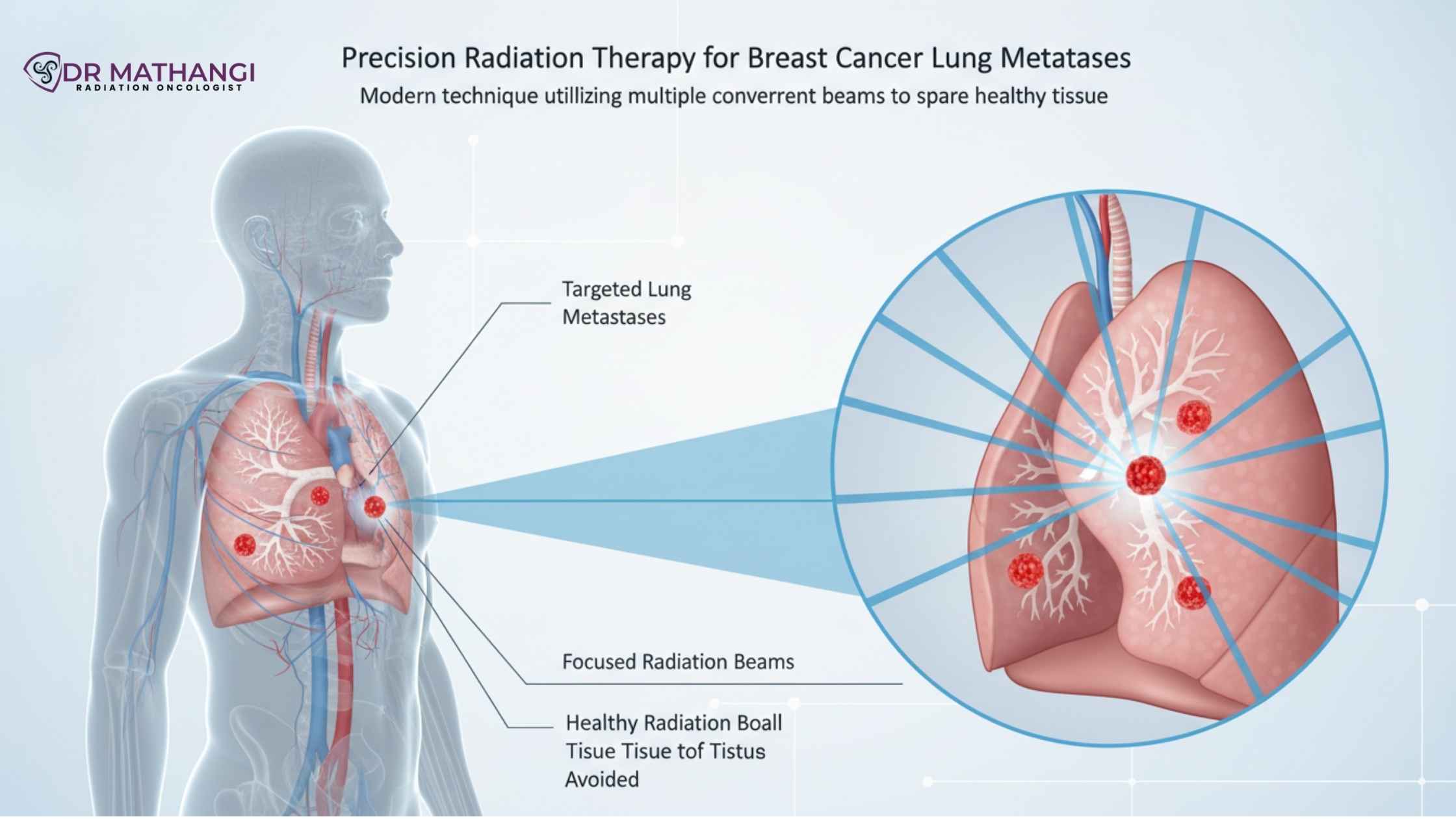
Nearly 20–30% of patients with advanced breast cancer may develop distant spread, and the lungs are among the most common sites of metastasis. When breast metastasis to lung occurs, timely and highly targeted intervention can significantly influence survival and quality of life. Precision Radiation For Breast Cancer Spread To Lungs has emerged as a breakthrough approach—offering hope where conventional therapies once had limitations.
At the forefront of this advancement is Dr Mathangi J, Sr Consultant & In-charge – Radiation Oncology at Gleneagles Cancer Institute, Bangalore. With over 20 years of experience and more than 12,000 successfully treated patients, she brings global expertise in stereotactic and image-guided radiotherapy to patients across South India and North India.
Breast metastasis to lung refers to the spread of cancer cells from the breast to lung tissue, forming secondary tumors. These are medically classified as a secondary malignant neoplasm of lung, not primary lung cancer.
The challenge lies in:
Conventional radiation may affect surrounding normal lung structures. Precision-based approaches like SBRT and gated radiotherapy ensure tumor-focused targeting while protecting vital respiratory function.
Precision radiation uses advanced imaging, respiratory gating, and stereotactic delivery systems to focus high doses of radiation directly onto metastatic lung lesions with sub-millimeter accuracy.
Her international training from Germany and Denmark ensures that patients receive globally benchmarked care within India.
Pulmonary metastases demand high accuracy because lungs are constantly moving. Precision radiation accounts for respiratory motion, allowing:
For patients dealing with emotional distress after learning of lung involvement, knowing that advanced technology exists can transform fear into confidence.
Many patients are asymptomatic initially. However, warning signs may include:
Early imaging detection followed by prompt intervention dramatically improves outcomes. Delaying precision therapy may allow lesions to grow or multiply.
| Parameter | Precision Radiation | Chemotherapy |
|---|---|---|
| Targeting | Localized to lung lesions | Systemic (whole body) |
| Side Effects | Limited to treated area | Hair loss, nausea, fatigue |
| Sessions | Few high-dose sessions (SBRT) | Multiple cycles over months |
| Precision | Sub-millimeter accuracy | Non-targeted systemic therapy |
While systemic therapy remains essential in many cases, combining it with Precision Radiation For Breast Cancer Spread To Lungs significantly improves local control.
Yes. The same advanced techniques are used for:
Each treatment plan is personalized after detailed imaging and tumor board evaluation.
Choosing the right radiation oncologist is not optional—it is critical. Dr Mathangi:
Her extensive expertise in stereotactic techniques (SRS/SBRT), IGRT, and DIBH ensures maximum tumor precision with minimal lung compromise.
Radiation therapy under Dr Mathangi’s leadership is used for:
Her multidisciplinary approach integrates medical oncology, surgical oncology, and advanced radiation planning.
Ignoring pulmonary metastases can lead to:
Early precision intervention changes the trajectory of disease progression. The difference between delayed care and expert-guided treatment may determine long-term control.
To consult Dr Mathangi for Precision Radiation For Breast Cancer Spread To Lungs or any other radiation therapy need, patients can submit their contact details via:
https://drmathangi.com/contact/
Her team will promptly schedule the appointment and notify you with consultation details.
Dr Mathangi J is a Senior Consultant & In-charge – Radiation Oncology (MBBS, DMRT, DNB) with over two decades of clinical excellence. She completed her DMRT at Madras Medical College, Chennai, and DNB residency at Apollo Cancer Specialty Hospital, Chennai. She received advanced training in:
She currently leads the Radiation Oncology department at Gleneagles Cancer Institute, Bangalore—one of India’s most advanced cancer centers.
Patients across South India and North India seek her expertise because precision is not just technology—it is experience, judgment, and commitment combined.