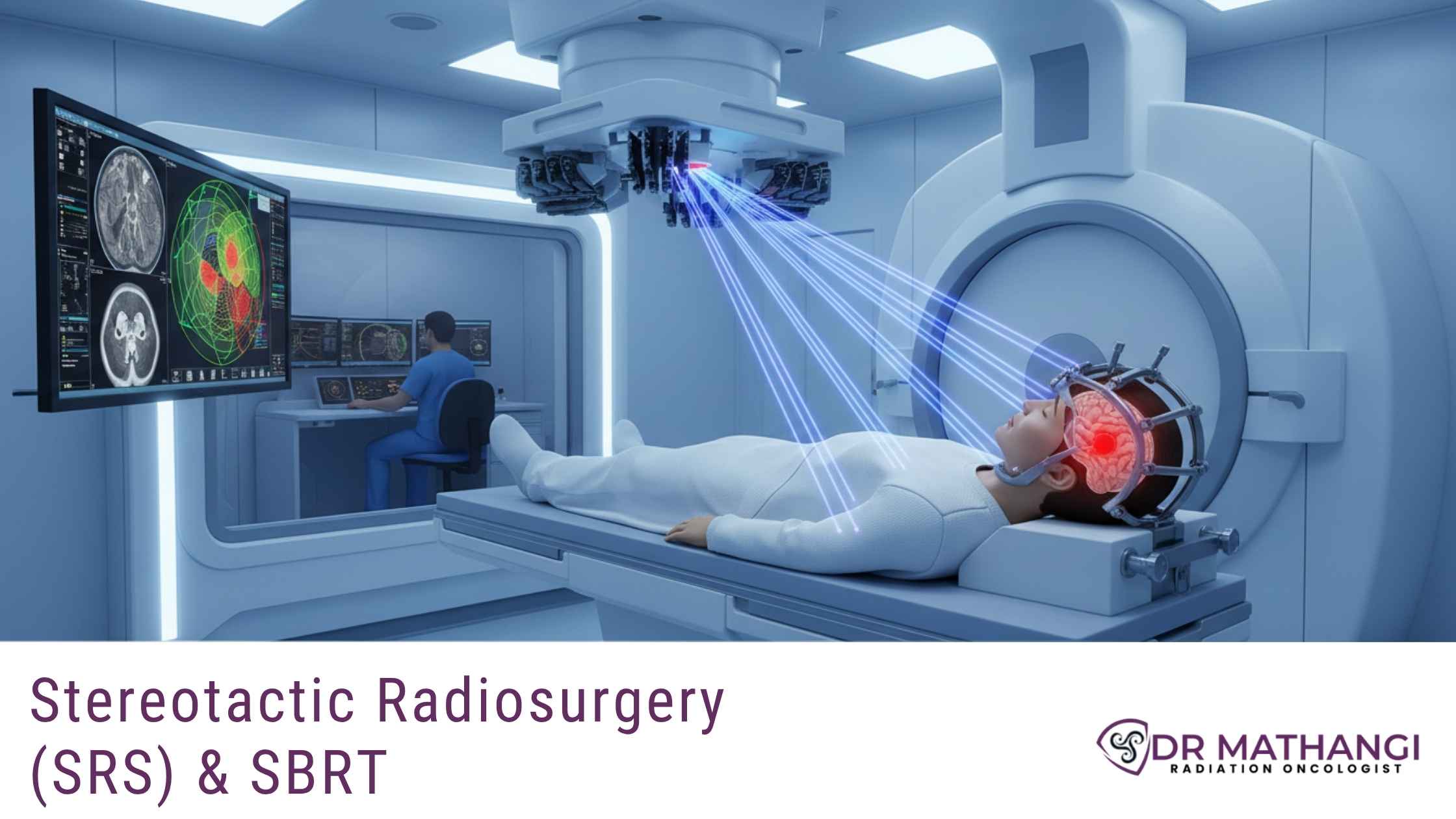
Stereotactic radiosurgery (SRS) & SBRT: Precision cancer care led by Dr Mathangi

Stereoactive radisurgery

Stereotactic radiosurgery delivers highly focused radiation with sub-millimeter accuracy, and clinical studies show local control rates exceeding 85–95% in selected brain and lung tumors. For patients seeking powerful, non-invasive cancer treatment, this precision-driven approach can mean fewer sessions, faster recovery, and better outcomes.

At the forefront of this revolution in cancer care is Dr Mathangi J, Sr Consultant & In-charge – Radiation Oncology at Gleneagles Cancer Institute, Bangalore. With over 20 years of experience and more than 12,000 successfully treated patients, she brings global training and technological excellence to every treatment plan she designs.

What is stereotactic radiosurgery and how does it work?

Stereotactic radiosurgery is an advanced form of radiation treatment that delivers extremely focused, high-dose radiation beams to a tumor while sparing surrounding healthy tissues. Unlike conventional radiation therapy that may require 25–35 sessions, SRS radiation therapy often completes treatment in one to five highly precise sessions.

This approach uses:

  • Advanced 3D imaging (MRI/CT fusion)
  • Computer-guided targeting systems
  • Immobilization devices for accuracy
  • Real-time image verification

The result is high dose precision radiotherapy that maximizes tumor destruction while minimizing side effects.

What is stereotactic body radiotherapy (SBRT)?

Stereotactic body radiotherapy extends the same precision principles of SRS to tumors located outside the brain, such as lung, liver, prostate, spine, and abdominal tumors. Often referred to as SBRT cancer treatment or SABR radiation therapy, it delivers ablative radiation doses in fewer sessions—typically 3 to 5.

Dr Mathangi is internationally trained in SRS and SBRT techniques from Klinikum Frankfurt (Oder), Germany, and IGRT/RapidArc from Copenhagen University Hospital, Denmark. This global expertise directly benefits patients across South India and North India seeking world-class treatment without traveling abroad.

Which cancers can be treated with SRS and SBRT?

SRS and SBRT are used in carefully selected patients for multiple tumor types. Under Dr Mathangi’s leadership, treatment plans are personalized based on tumor size, location, stage, and patient health.

Cancers commonly treated with these advanced techniques include:

  • Head and neck cancers
  • Brain tumors (primary and metastatic)
  • Spine tumors
  • Lung cancers
  • Liver cancers
  • Breast cancers
  • Bladder cancers
  • Prostate cancers
  • Uterine cancers
  • Cervical cancer
  • Vulval cancers
  • Anal canal cancers
  • Penile cancers
  • Esophagus and rectal cancers

For example, brain tumor radiation therapy using SRS allows high-dose treatment in a single session for selected lesions. Similarly, lung cancer radiation therapy using SBRT is particularly effective in early-stage non-small cell lung cancer patients who are not surgical candidates.

Why choose high dose precision radiotherapy over conventional radiation?

Conventional radiation therapy treats larger areas over many sessions. While effective, it may expose more healthy tissue to radiation. In contrast, high dose precision radiotherapy concentrates radiation only on the tumor.

Feature Conventional RT SRS / SBRT
Number of sessions 25–35 1–5
Precision level Moderate Sub-millimeter accuracy
Dose per session Lower Higher (ablative)
Recovery time Longer Shorter

The advantage is clear: fewer hospital visits, less disruption to daily life, and potentially improved tumor control.

How does Dr Mathangi ensure safety and accuracy?

Technology alone does not guarantee outcomes—experience does. Dr Mathangi has installed Asia Pacific’s first TrueBeam STx machine and heads the radiation oncology department at her center.

Her protocol includes:

  1. Comprehensive clinical evaluation
  2. Advanced imaging with CT-MRI fusion
  3. Motion management techniques like DIBH gated Radiotherapy
  4. Gated RapidArc planning
  5. Image-guided verification before each session

For tumors affected by breathing motion, such as lung and liver tumors, respiratory gating ensures radiation is delivered only when the tumor is in the correct position. This level of detail dramatically improves outcomes in SBRT cancer treatment.

Is stereotactic radiosurgery painful or invasive?

No. Despite the term “surgery,” stereotactic radiosurgery is completely non-invasive. There are no incisions, no stitches, and no prolonged hospital stay. Most patients return home the same day.

This is particularly reassuring for patients with brain metastases or small primary brain tumors requiring SRS radiation therapy, where open surgery may carry higher risks.

What makes Dr Mathangi different?

Dr Mathangi is not just a radiation oncologist; she is a leader in advanced radiotherapy techniques. Her credentials include:

  • MBBS, DMRT, DNB
  • Advanced stereotactic training in Germany
  • IGRT/RapidArc training in Denmark
  • Expertise in image-guided Interstitial Brachytherapy
  • Director of Fellowship in Advanced Radiotherapy Techniques (RGUHS affiliated)

She specializes in:

  • Head and Neck Cancers
  • Prostate Cancers
  • Brain Tumors
  • Lung Cancers
  • Women Cancers (Breast, Cervix, Endometrium)

Her extensive experience ensures that every patient receives a personalized plan rather than a standardized protocol.

What is the patient journey like?

The treatment pathway under Dr Mathangi is structured, transparent, and patient-centric.

Step 1: Consultation

A thorough evaluation including medical history, imaging review, and multidisciplinary discussion.

Step 2: Simulation and planning

High-resolution imaging is performed to map the tumor precisely. Treatment planning software calculates optimal radiation angles and doses.

Step 3: Delivery of stereotactic body radiotherapy or SRS radiation therapy

Treatment is delivered using image guidance and real-time monitoring.

Step 4: Follow-up and monitoring

Regular imaging and clinical assessments ensure treatment success and early detection of any recurrence.

Why patients across India choose Dr Mathangi

Cancer patients often delay advanced treatment due to uncertainty. The real risk is not choosing expertise when it matters most. With global training, cutting-edge technology, and thousands of success stories, Dr Mathangi offers confidence when patients need it most.

Patients from South India and North India travel to Bangalore for:

  • Access to advanced SABR radiation therapy
  • Expert-led brain tumor radiation therapy
  • Precision-focused lung cancer radiation therapy
  • Globally benchmarked stereotactic protocols

When time is critical, waiting is not an option. Choosing a specialist who has mastered stereotactic body radiotherapy can significantly impact survival and quality of life.

About Dr Mathangi

Dr Mathangi J is a Senior Radiation Oncologist based in Bangalore, India, specializing in advanced radiation techniques including stereotactic radiosurgery and SBRT cancer treatment. She leads the radiation oncology department at Gleneagles Cancer Institute and is recognized for pioneering innovations such as installing the Asia Pacific’s first TrueBeam STx machine.

Her mission is clear: deliver precision, preserve quality of life, and provide hope through science-backed cancer care.

Book your consultation today

If you or your loved one has been advised radiation therapy, do not settle for outdated approaches. Explore advanced high dose precision radiotherapy with Dr Mathangi.

To book an appointment, submit your contact information through the form at: https://drmathangi.com/contact/. Her team will schedule your consultation and notify you promptly.

Your health deserves precision. Your future deserves expertise.

Frequently Asked Questions – Stereotactic Radiosurgery (SRS) & SBRT

stereotactic radiosurgery is a highly precise, non-invasive radiation technique that delivers a concentrated dose of radiation to a well-defined target in the brain or spine. Despite the name, it does not involve any surgical incision. Instead, advanced imaging and computer-guided planning allow Dr. Mathangi to focus radiation beams with sub-millimeter accuracy.

Unlike conventional radiation, which is typically delivered over many weeks in small daily doses, SRS radiation therapy is often completed in one to five sessions. This approach minimizes radiation exposure to surrounding healthy tissues while achieving excellent tumor control. It is especially effective for small brain tumors, metastases, arteriovenous malformations, and certain functional disorders.

SRS radiation therapy is commonly used for both benign and malignant brain lesions. This includes primary brain tumors, brain metastases from cancers elsewhere in the body, acoustic neuromas, meningiomas, and certain pituitary tumors.

Dr. Mathangi also uses this approach in selected cases requiring brain tumor radiation therapy where precision is critical. By tailoring dose and targeting based on each patient’s imaging, she ensures that the treatment is both safe and effective, with minimal disruption to daily life.

stereotactic body radiotherapy is the body equivalent of SRS, used for tumors outside the brain. It delivers very focused, high-intensity radiation to tumors in areas such as the lungs, liver, pancreas, spine, or prostate.

This technique is also referred to as SBRT cancer treatment or SABR radiation therapy. The principle remains the same: high dose precision radiotherapy delivered over a few sessions, with careful immobilization and image guidance to ensure accuracy. Dr. Mathangi’s expertise lies in meticulous planning, ensuring maximum tumor control while protecting nearby organs.

Yes, SBRT cancer treatment is widely used for early-stage lung tumors, especially in patients who may not be ideal candidates for surgery. lung cancer radiation therapy using SBRT allows delivery of ablative doses directly to the tumor with remarkable precision.

With advanced motion management techniques to account for breathing, Dr. Mathangi ensures that radiation remains accurately targeted throughout treatment. For many patients, this means effective tumor control in just three to five sessions, with minimal hospital visits.

high dose precision radiotherapy refers to the delivery of powerful radiation doses directly to a tumor while sparing surrounding healthy tissue. This is made possible by advanced imaging, 3D treatment planning, and real-time verification during each session.

Under Dr. Mathangi’s supervision, every treatment plan undergoes strict quality checks. This precision reduces side effects compared to conventional techniques and often results in shorter treatment schedules and faster recovery times.

For brain tumor radiation therapy using stereotactic radiosurgery, patients first undergo detailed imaging such as MRI or CT scans. These images help map the exact size, shape, and location of the tumor.

Treatment itself is painless and typically completed in a single session or a few sessions. Most patients return home the same day. Dr. Mathangi provides clear pre- and post-treatment guidance to ensure comfort, safety, and optimal outcomes.

SABR radiation therapy usually requires between one and five sessions, depending on the tumor type, size, and location. Because the doses are higher per session compared to traditional radiation, the total number of treatments is significantly reduced.

Dr. Mathangi carefully determines the number of sessions after reviewing imaging, biopsy results, and overall health status. Her goal is to deliver the most effective treatment in the shortest safe timeframe.

Ideal candidates for SRS radiation therapy or stereotactic body radiotherapy are patients with small, well-defined tumors that can be clearly visualized on imaging. It is particularly beneficial for patients seeking a non-surgical option or those who may not tolerate major surgery.

During consultation, Dr. Mathangi evaluates tumor characteristics, stage, previous treatments, and overall health. Based on this comprehensive assessment, she recommends the most appropriate approach, ensuring personalized care and evidence-based decision-making.

By using this website - You confirm to have read and agree to the Disclaimer statement, Privacy Policy and the Terms & Conditions of this website.
Chat
linkedin facebook pinterest youtube rss twitter instagram facebook-blank rss-blank linkedin-blank pinterest youtube twitter instagram