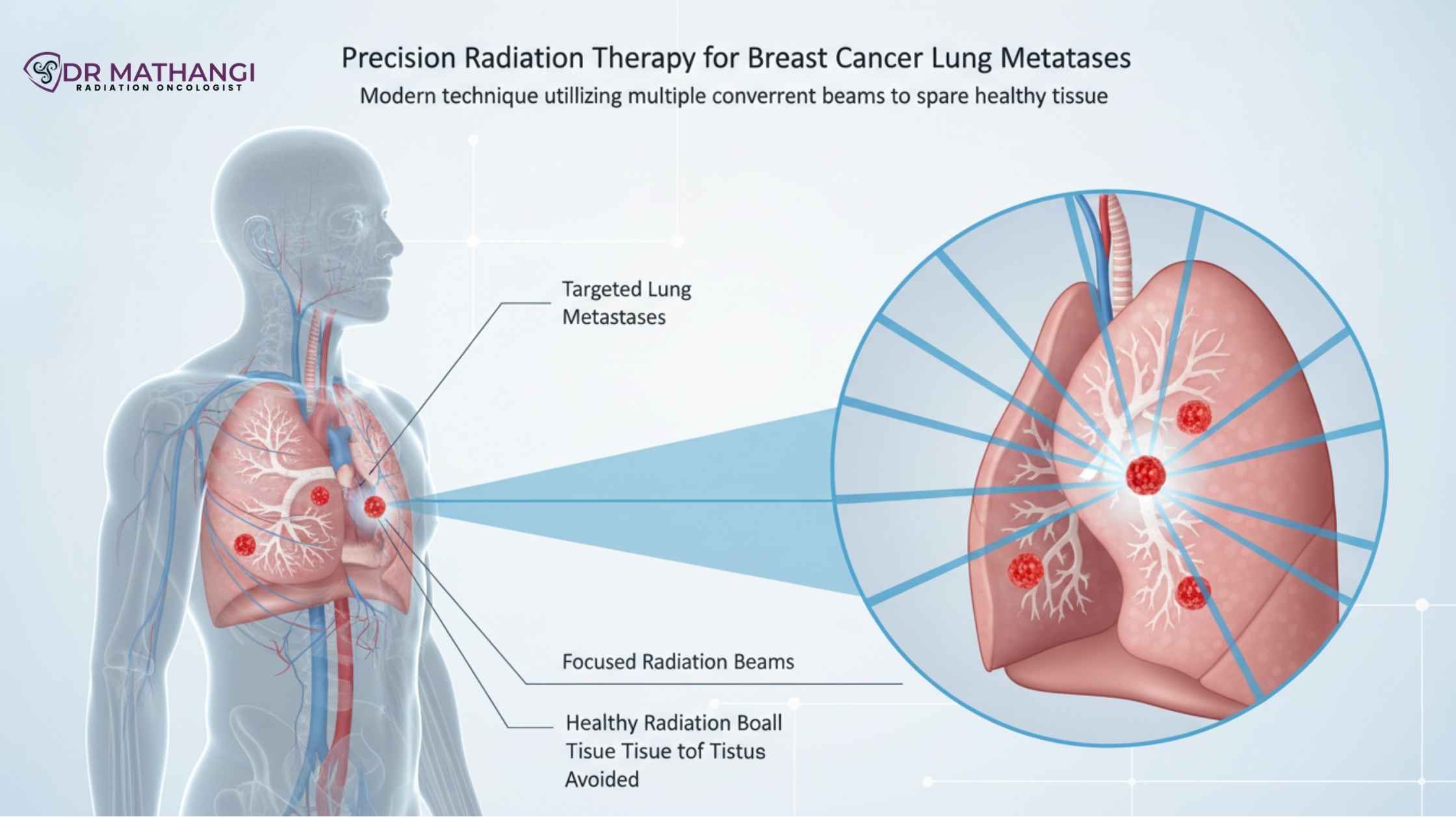
Precision Radiation For Breast Cancer Spread To Lungs

Radiiation for breast cancer

Nearly 20–30% of patients with advanced breast cancer may develop distant spread, and the lungs are among the most common sites of metastasis. When breast metastasis to lung occurs, timely and highly targeted intervention can significantly influence survival and quality of life. Precision Radiation For Breast Cancer Spread To Lungs has emerged as a breakthrough approach—offering hope where conventional therapies once had limitations.

At the forefront of this advancement is Dr Mathangi J, Sr Consultant & In-charge – Radiation Oncology at Gleneagles Cancer Institute, Bangalore. With over 20 years of experience and more than 12,000 successfully treated patients, she brings global expertise in stereotactic and image-guided radiotherapy to patients across South India and North India.

What Is Breast Metastasis To Lung And Why Does It Need Precision Care?

Breast metastasis to lung refers to the spread of cancer cells from the breast to lung tissue, forming secondary tumors. These are medically classified as a secondary malignant neoplasm of lung, not primary lung cancer.

The challenge lies in:

  • Multiple small nodules scattered within lung tissue
  • Movement of lungs during breathing
  • Need to preserve healthy lung tissue
  • Preventing further pulmonary metastases

Conventional radiation may affect surrounding normal lung structures. Precision-based approaches like SBRT and gated radiotherapy ensure tumor-focused targeting while protecting vital respiratory function.

How Does Precision Radiation For Breast Cancer Spread To Lungs Work?

Precision radiation uses advanced imaging, respiratory gating, and stereotactic delivery systems to focus high doses of radiation directly onto metastatic lung lesions with sub-millimeter accuracy.

Key Technologies Used By Dr Mathangi

  • Stereotactic Ablative Body Radiotherapy (SBRT)
  • Gated RapidArc Technology
  • DIBH Gated Radiotherapy (Deep Inspiration Breath Hold)
  • Image-Guided Radiotherapy (IGRT)
  • TrueBeam STx Machine – Asia Pacific’s first installation under her leadership

Her international training from Germany and Denmark ensures that patients receive globally benchmarked care within India.

Why Is Precision Radiation Superior For Pulmonary Metastases?

Pulmonary metastases demand high accuracy because lungs are constantly moving. Precision radiation accounts for respiratory motion, allowing:

  • Higher tumor control rates
  • Minimal damage to surrounding lung tissue
  • Reduced treatment sessions
  • Faster recovery
  • Lower long-term side effects

For patients dealing with emotional distress after learning of lung involvement, knowing that advanced technology exists can transform fear into confidence.

What Symptoms Suggest Secondary Malignant Neoplasm Of Lung?

Many patients are asymptomatic initially. However, warning signs may include:

  • Persistent cough
  • Shortness of breath
  • Chest discomfort
  • Fatigue
  • Unexplained weight loss

Early imaging detection followed by prompt intervention dramatically improves outcomes. Delaying precision therapy may allow lesions to grow or multiply.

How Is Precision Radiation Different From Chemotherapy For Breast Metastasis To Lung?

Parameter Precision Radiation Chemotherapy
Targeting Localized to lung lesions Systemic (whole body)
Side Effects Limited to treated area Hair loss, nausea, fatigue
Sessions Few high-dose sessions (SBRT) Multiple cycles over months
Precision Sub-millimeter accuracy Non-targeted systemic therapy

While systemic therapy remains essential in many cases, combining it with Precision Radiation For Breast Cancer Spread To Lungs significantly improves local control.

Does Precision Radiation Help Other Lung Metastases?

Yes. The same advanced techniques are used for:

Each treatment plan is personalized after detailed imaging and tumor board evaluation.

Why Choose Dr Mathangi For Lung Metastasis Radiation?

Choosing the right radiation oncologist is not optional—it is critical. Dr Mathangi:

  • Has treated over 12,000 cancer patients successfully
  • Heads Radiation Oncology at Gleneagles Cancer Institute, Bangalore
  • Installed Asia Pacific’s first TrueBeam STx Machine
  • Is Director of Fellowship in Advanced Radiotherapy Techniques (RGUHS affiliated)
  • Specializes in breast, lung, prostate, brain, head and neck cancers

Her extensive expertise in stereotactic techniques (SRS/SBRT), IGRT, and DIBH ensures maximum tumor precision with minimal lung compromise.

What Other Cancers Require Radiation Therapy?

Radiation therapy under Dr Mathangi’s leadership is used for:

  1. Head and neck cancers
  2. Brain tumors
  3. Spine tumors
  4. Esophagus and rectal cancers
  5. Lung cancers
  6. Liver cancers
  7. Breast cancers
  8. Bladder cancers
  9. Prostate cancers
  10. Uterine cancers
  11. Cervical cancer
  12. Vulval cancers
  13. Anal canal cancers
  14. Penile cancers

Her multidisciplinary approach integrates medical oncology, surgical oncology, and advanced radiation planning.

What Happens If Lung Metastases Are Left Untreated?

Ignoring pulmonary metastases can lead to:

  • Progressive breathing difficulty
  • Spread to additional organs
  • Reduced survival
  • Severe quality-of-life decline

Early precision intervention changes the trajectory of disease progression. The difference between delayed care and expert-guided treatment may determine long-term control.

How To Book An Appointment With Dr Mathangi?

To consult Dr Mathangi for Precision Radiation For Breast Cancer Spread To Lungs or any other radiation therapy need, patients can submit their contact details via:

https://drmathangi.com/contact/

Her team will promptly schedule the appointment and notify you with consultation details.

About Dr Mathangi

Dr Mathangi J is a Senior Consultant & In-charge – Radiation Oncology (MBBS, DMRT, DNB) with over two decades of clinical excellence. She completed her DMRT at Madras Medical College, Chennai, and DNB residency at Apollo Cancer Specialty Hospital, Chennai. She received advanced training in:

  • Stereotactic techniques (Germany)
  • IGRT/RapidArc (Denmark)
  • Intraoperative radiotherapy (IORT)

She currently leads the Radiation Oncology department at Gleneagles Cancer Institute, Bangalore—one of India’s most advanced cancer centers.

Patients across South India and North India seek her expertise because precision is not just technology—it is experience, judgment, and commitment combined.


Frequently Asked Questions – Precision Radiation for Breast Cancer Spread to Lungs

When breast cancer cells travel from the original tumor to the lungs, it is known as breast metastasis to lung. This is considered an advanced stage of the disease, but it is still treated as breast cancer, not lung cancer. The cancer cells retain the biological characteristics of breast tissue, and treatment is planned accordingly.

Dr. Mathangi evaluates the number, size, and location of pulmonary lesions and designs a personalized precision radiation plan, often in combination with systemic therapy, to control disease progression and relieve symptoms.

A secondary malignant neoplasm of lung refers to cancer that has spread from another organ to the lungs. In contrast, primary lung cancer originates within lung tissue itself.

This distinction is crucial because treatment protocols differ significantly. In metastatic cases from breast cancer, radiation is targeted to metastatic nodules while systemic therapy addresses microscopic disease. Dr. Mathangi uses advanced imaging and pathology correlation to ensure accurate diagnosis before initiating precision radiation.

Pulmonary metastases are cancer deposits in the lungs that have spread from a primary tumor elsewhere in the body. In selected patients with limited lesions, highly focused radiation techniques such as stereotactic body radiation therapy (SBRT) can deliver high doses directly to tumors while sparing healthy lung tissue.

Dr. Mathangi’s approach involves detailed planning scans, respiratory motion management, and image-guided radiation delivery to maximize tumor control and minimize side effects such as breathlessness or radiation pneumonitis.

Yes, even in advanced stages, precision radiation can play an important role. For patients with limited lung involvement, it may help achieve long-term local control. In more widespread disease, it can relieve symptoms such as persistent cough, chest discomfort, or breathing difficulty.

Dr. Mathangi carefully assesses overall disease burden, prior treatments, and patient fitness before recommending radiation, ensuring that therapy aligns with long-term care goals and quality of life considerations.

Yes, precision radiation can be used for skin cancer metastasis to lung when lesions are limited and technically suitable for targeted therapy. Each case is evaluated individually based on tumor biology, prior treatments, and systemic disease status.

Dr. Mathangi integrates multidisciplinary opinions, including medical oncology and surgical teams, to determine whether stereotactic radiation or conventional fractionated radiation is most appropriate.

Precision radiation techniques allow higher doses to be delivered directly to tumor sites with millimeter accuracy. This reduces exposure to surrounding lung tissue, heart, and esophagus. Treatment duration is often shorter, and recovery is typically quicker.

Under Dr. Mathangi’s supervision, advanced planning systems and image guidance ensure optimal dose distribution, improving tumor control while lowering the risk of complications.

Most patients tolerate precision radiation well. Some may experience mild fatigue, temporary cough, or slight chest discomfort. Serious side effects are uncommon when advanced planning techniques are used.

Dr. Mathangi provides continuous monitoring during and after treatment, with regular follow-ups and imaging to evaluate response and manage any early signs of radiation-related inflammation.

Each treatment plan begins with a comprehensive evaluation including PET-CT imaging, prior treatment history, and molecular tumor characteristics. Whether managing pulmonary metastases from breast cancer or another primary tumor, therapy is customized to balance effectiveness and safety.

By combining precision radiation with systemic therapies and close multidisciplinary collaboration, Dr. Mathangi aims to provide comprehensive, evidence-based care focused on extending survival and preserving quality of life.

By using this website - You confirm to have read and agree to the Disclaimer statement, Privacy Policy and the Terms & Conditions of this website.
Copyright © Dr. Mathangi. All Rights Reserved. 
    Run by Widepool
Chat
linkedin facebook pinterest youtube rss twitter instagram facebook-blank rss-blank linkedin-blank pinterest youtube twitter instagram