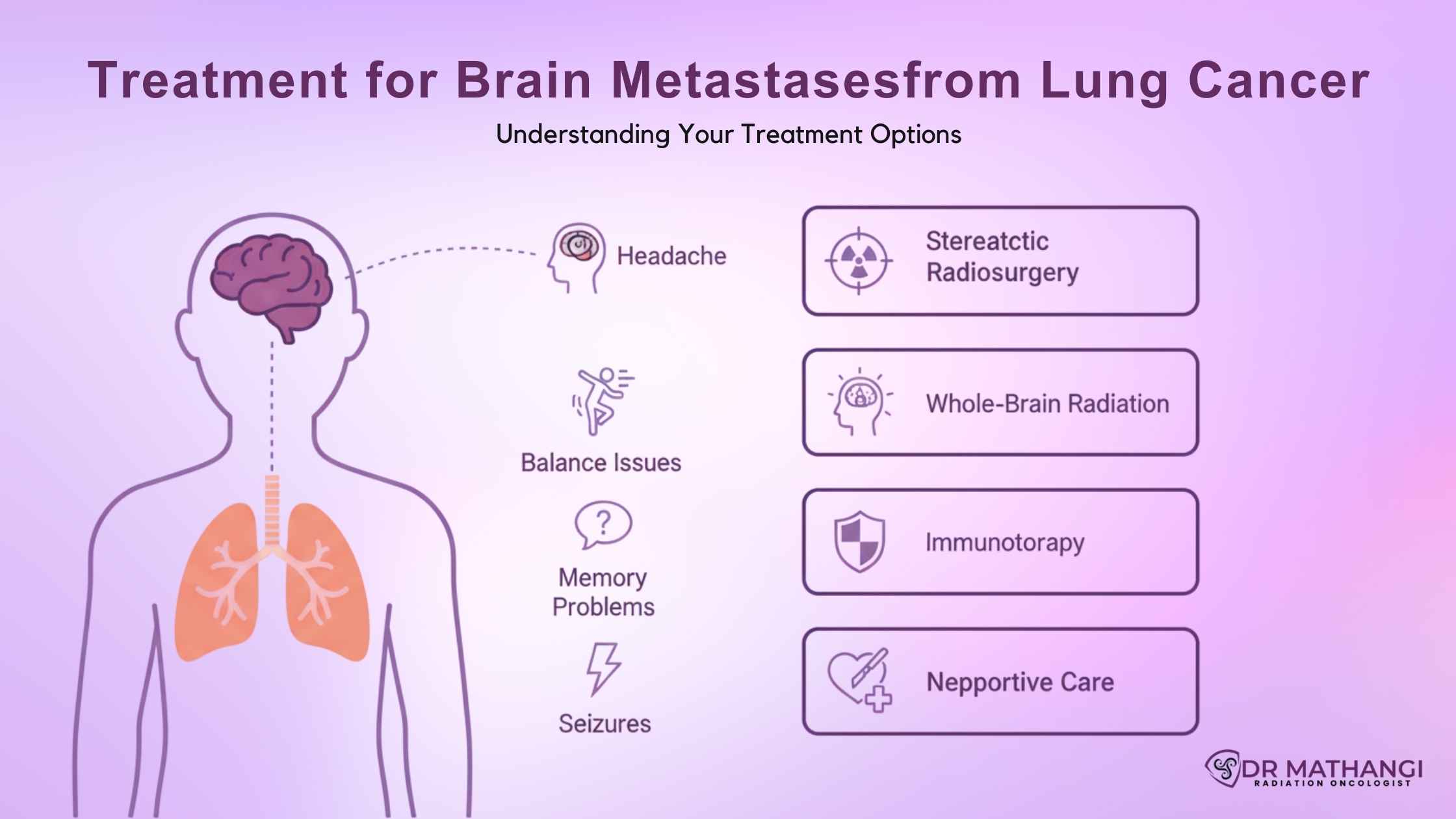
Up to 20–40% of patients with lung cancer develop brain metastases during the course of their illness. This makes treatment for brain metastases from lung cancer one of the most urgent and life-altering decisions a patient and family will ever face. When lung cancer spreads to the brain, time, precision, and expertise matter — and this is where Dr Mathangi, Senior Consultant & In-charge of Radiation Oncology at Gleneagles Cancer Institute, Bangalore, brings more than two decades of focused excellence.
treatment for lung cancer that has spread to the brain refers to a combination of advanced radiation therapy, targeted therapy, immunotherapy, and in select cases, surgery, aimed at controlling brain lesions, relieving symptoms, and extending survival while preserving neurological function.
The moment brain involvement is diagnosed, patients often feel overwhelmed. Headaches, seizures, memory disturbances, or weakness may appear suddenly. The problem? Brain metastases can rapidly affect quality of life. The agitation? Without precise treatment, neurological damage can become permanent. The solution? Highly specialized, image-guided radiation techniques delivered by an experienced radiation oncologist like Dr Mathangi.
lung cancer with brain metastases treatment is complex because it must balance tumor control with protection of healthy brain tissue. The brain governs speech, memory, mobility, and personality. Even minor inaccuracies can have major consequences.
Dr Mathangi’s advanced training in Stereotactic techniques (SRS/SBRT) from Germany and IGRT/RapidArc from Denmark allows her to deliver sub-millimeter precision radiation. With over 12,000 successfully treated patients and leadership in installing Asia Pacific’s first TrueBeam STx Machine, her approach represents the convergence of technology and compassionate expertise.
radiation for brain mets from lung cancer uses high-energy beams to destroy metastatic cancer cells in the brain while sparing surrounding healthy tissue.
Unlike traditional whole-brain radiation, modern stereotactic radiation minimizes cognitive decline. This is critical when preserving memory and executive function.
metastatic lung cancer to the brain survival depends on multiple factors including number of brain lesions, genetic mutations, systemic disease control, patient performance status, and the timeliness of advanced radiation therapy.
With the integration of:
Survival outcomes today are significantly improved compared to a decade ago. Early, aggressive, and technically precise treatment can transform prognosis.
Dr Mathangi J is a Senior Consultant & In-charge – Radiation Oncology at Gleneagles Cancer Institute, Bangalore. With MBBS, DMRT, and DNB qualifications, and international training across Germany and Denmark, she specializes in:
Her expertise in stereotactic brain radiation is particularly vital for patients requiring treatment for brain metastases from lung cancer. When precision defines outcome, experience defines precision.
Immediate evaluation with MRI brain imaging is critical. Delay can reduce treatment effectiveness.
Dr Mathangi follows a structured, evidence-based pathway:
This ensures that lung cancer with brain metastases treatment is not generic, but biologically and anatomically customized.
The longer brain metastases remain untreated, the higher the risk of irreversible neurological damage. Many patients mistakenly believe systemic chemotherapy alone will control brain lesions. However, the blood-brain barrier often limits drug penetration. This is where radiation for brain mets from lung cancer becomes indispensable.
When patients delay advanced radiation therapy, they risk:
Timely intervention by a senior radiation oncologist can mean the difference between symptom control and neurological decline.
Older whole-brain techniques were associated with memory loss. Today’s stereotactic radiation focuses only on visible lesions. With millimetric precision and image guidance:
This technological leap is central to improving metastatic lung cancer to the brain survival.
Radiation therapy is also essential in managing:
This breadth of expertise strengthens decision-making in complex metastatic scenarios.
Patients from Karnataka, Tamil Nadu, Kerala, Telangana, Andhra Pradesh, Maharashtra, Delhi, and other regions travel to Bangalore seeking advanced treatment for lung cancer that has spread to the brain. The reasons are clear:
When facing a life-threatening diagnosis, settling for ordinary care is not an option.
If you or your loved one has been diagnosed with brain metastases from lung cancer, early specialist intervention is critical. Dr Mathangi’s team will guide you through every stage — from evaluation to precision radiation therapy and follow-up care.
To book an appointment, submit your contact information through the form at:
https://drmathangi.com/contact/
Her team will schedule your consultation and notify you promptly.
Dr Mathangi J is a leading Radiation Oncologist based in Bangalore, serving patients across South India and North India. She is Senior Consultant & In-charge – Radiation Oncology at Gleneagles Cancer Institute. With over 12,000 treated patients and international training in advanced stereotactic techniques, she represents the highest standards of precision-driven cancer care.
When lung cancer spreads to the brain, it is called brain metastasis. This happens when cancer cells travel through the bloodstream and form new tumors in the brain. It is a serious but treatable condition. Early detection through MRI scans and prompt specialist care significantly improve outcomes.
Dr. Mathangi carefully evaluates each patient’s symptoms, imaging findings, overall health, and molecular profile of the tumor before recommending a personalized treatment plan. Her approach focuses not only on controlling the disease but also on preserving neurological function and quality of life.
The best treatment for lung cancer that has spread to the brain depends on several factors, including the number of brain lesions, their size and location, genetic mutations in the tumor, and the patient’s general health.
Options may include stereotactic radiosurgery, whole-brain radiation therapy, targeted therapy, immunotherapy, chemotherapy, or a combination of these. In selected cases, surgery may also be considered. Dr. Mathangi designs an individualized care strategy that balances effective tumor control with minimal side effects.
Radiation for brain mets from lung cancer is one of the most commonly used and effective treatments. Techniques such as stereotactic radiosurgery deliver high-dose radiation precisely to tumor areas while sparing healthy brain tissue.
For patients with multiple metastases, whole-brain radiation therapy may be advised. Dr. Mathangi works closely with radiation oncology specialists to ensure precise planning and monitoring, aiming to reduce symptoms such as headaches, seizures, or neurological deficits.
Lung cancer with brain metastases treatment typically involves a multidisciplinary approach. This may include:
• Targeted therapy for tumors with specific genetic mutations
• Immunotherapy to boost the body’s immune response
• Radiation therapy for local brain control
• Surgery in selected patients
• Systemic chemotherapy when appropriate
Dr. Mathangi ensures that patients undergo molecular testing, which helps identify targeted treatment options that can cross the blood-brain barrier and act effectively within the brain.
Metastatic lung cancer to the brain survival depends on factors such as the patient’s age, overall health, number of brain lesions, control of the primary lung tumor, and whether the cancer has specific targetable mutations.
Advances in targeted therapy and immunotherapy have significantly improved survival outcomes in recent years. With timely intervention and expert care under Dr. Mathangi, many patients experience better disease control and improved quality of life compared to historical outcomes.
Yes. Many modern targeted therapies are designed to penetrate the blood-brain barrier and control metastases in the brain. Immunotherapy can also play a role in selected patients.
Dr. Mathangi emphasizes molecular profiling to identify EGFR, ALK, ROS1, and other mutations that may respond well to advanced targeted medications. This precision-based approach often reduces the need for aggressive treatments and improves symptom control.
Dr. Mathangi adopts a patient-centric and evidence-based approach. She carefully reviews imaging, pathology reports, genetic markers, and overall performance status before recommending therapy.
Her solutions include coordinating multidisciplinary tumor board discussions, offering access to advanced radiation techniques, prescribing cutting-edge targeted therapies, and providing supportive care to manage neurological symptoms. This comprehensive strategy ensures patients receive holistic and compassionate care at every stage.